
Behavior Beats Math: The Overlooked Half of the Refinance Decision
A Follow-Up to The Amortization Trap


By Gary Field | April 2026
A quick note before we begin: the book recommendations at the end include affiliate links. Small commission to me, no cost to you, and I only link to books I actually recommend.
In my last piece, The Amortization Trap: Why a “Lower Rate” Refinance Can Be a Wealth Illusion, I walked through why many refinances that appear to save money actually quietly destroy wealth. The math is the math. Closing costs, the amortization reset, and the equity you stop building add up fast. For most borrowers under typical behavior, refinancing into a new 30-year loan does more harm than good.
Everything in that article remains true. I stand by every number.
One quick note before we go further: this is a longer piece. You may want to grab a cup of coffee—or a glass of wine—before diving in.
There is a second half to this story that I did not tell — and it’s worth telling now. Because the same refinance that erodes wealth under one behavior pattern can build wealth under another. The math doesn’t change. The behavior around it does. And that difference is where real wealth is either built or quietly lost.
This piece is about that difference.
The Insight: Behavior Changes the Math
When a lender hands you a lower payment, something happens automatically. The old payment was, say $2,850. The new one is $2,550. You have $300 more per month in your checking account. Most people, without thinking about it, let that $300 dissolve into life. A slightly nicer car payment. A few more dinners out. A streaming service here, a subscription there. Within a few months, the cash flow relief is invisible.
This is the default behavior. And under this behavior, my original analysis holds. The refinance costs you more than it saves because the $300 was the only thing standing between a wealth-eroding refinance and a break-even one.
But imagine, instead, that you took that $300 and applied it as an extra principal payment on the new mortgage every single month. The math transforms. You offset the amortization reset. You accelerate your payoff. You build more equity faster than you would have under the old loan. The same refinance that destroyed wealth under default behavior now builds it.
This isn’t a loophole. It’s the honest full picture.
The Side-by-Side Math
Let me return to the example from the original article. A Southern New Hampshire homeowner with a $380,000 balance at 7.25%, refinancing to 6.40%, 7 years into a 30-year loan, $14,000 in closing costs, planning to stay 60 months.
Scenario A: Default Behavior
The borrower refinances, enjoys the lower payment, and absorbs the savings into daily life. Under my original analysis:
• Gross monthly interest savings: +$228
• Closing cost spread over 60 months: −$233
• Principal opportunity cost (amortization reset): −$168
• Net wealth impact: −$173 per month
Over the 60 months they plan to stay, that’s roughly $10,400 in wealth erosion. The payment went down. The net worth went down faster.
Scenario B: Disciplined Behavior
Same borrower, same refinance, but this time they commit to redirecting the full payment savings — approximately $300 per month in total cash flow relief — straight to principal as an extra payment.
Now the math shifts:
• The monthly extra principal payment outpaces the amortization reset effect
• Additional principal paid over 60 months: roughly $18,000
• Combined with natural amortization, the loan is ahead of where the original loan would have been
• Net wealth impact: approximately +$127 per month, plus the loan pays off 6 to 8 years early
The difference between Scenario A and Scenario B is $300 per month in behavior. Nothing else changed. Not the rate. Not the closing costs. Not the loan terms. Only what the borrower did with their cash flow relief.
That’s how powerful behavior is. It turns the same refinance from a quiet wealth destroyer into a steady wealth builder.
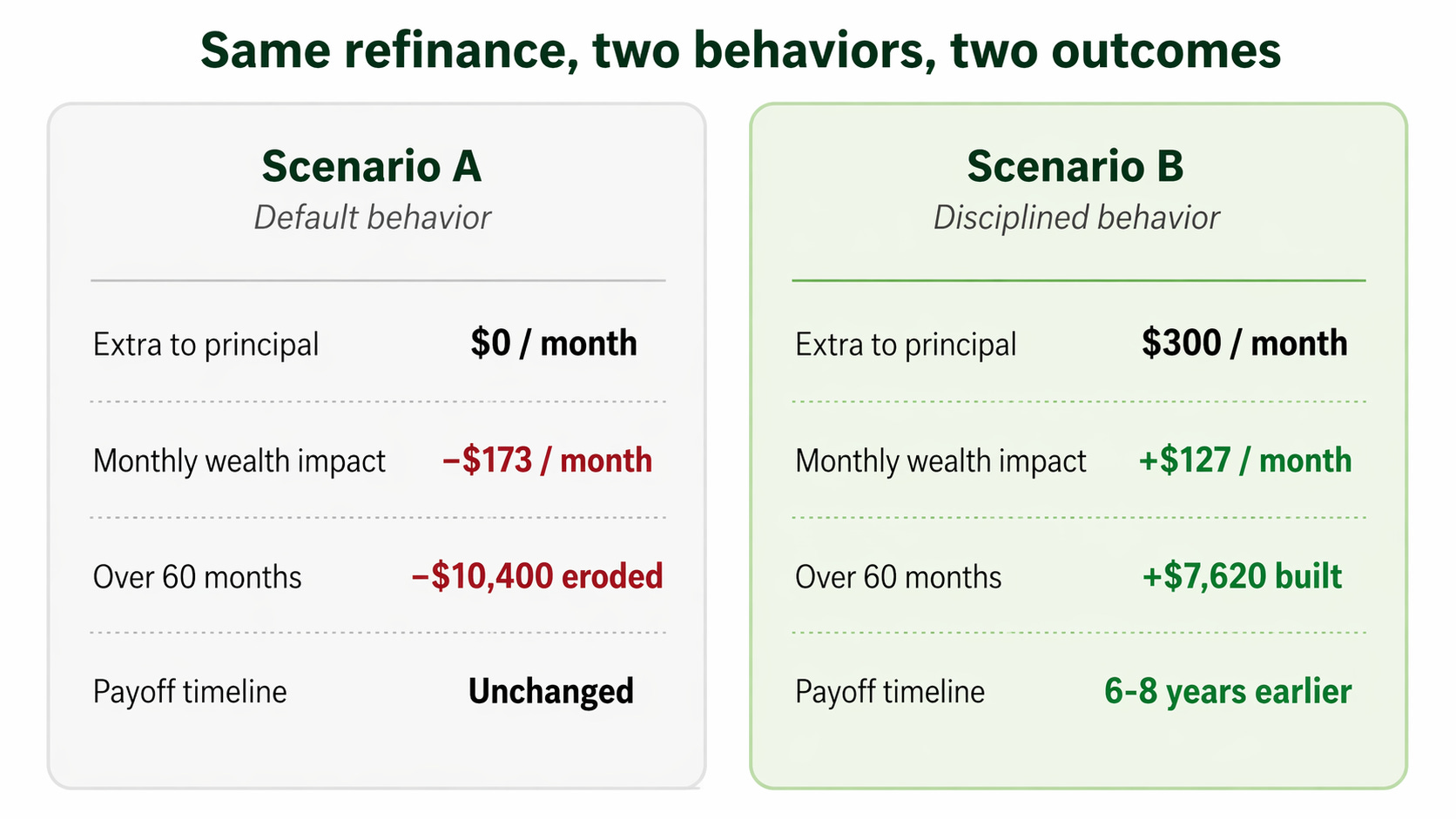
The difference between wealth destruction and wealth creation isn’t the refinance — it’s $300 per month in behavior.
Why This Is Harder Than It Sounds
The math is simple. The execution is not.
Cash flow relief feels like a raise. The brain doesn’t distinguish between “I earned more” and “I owe less.” Both register as more money available. And when more money becomes available, lifestyle expands to match. This is such a well-documented pattern that economists have a name for it: lifestyle creep. It’s the reason most income raises don’t produce corresponding wealth gains. It’s the reason most refinances that could have built wealth end up destroying it instead.
Without a deliberate, systematic plan to redirect cash flow, the $300 will quietly disappear. Not because anyone is irresponsible. Because that’s what humans do with available money.
So the question isn’t whether the math works. The math works. The question is whether you have the structure in place to make the behavior happen automatically, every single month, for years.
Four Behavior Mechanisms That Actually Work
These are the mechanisms I’ve seen work in practice — not in theory. If you’re going to commit to Scenario B, pick one or more of these and set it up immediately after closing. Not next month. Not when you have time. The same day.
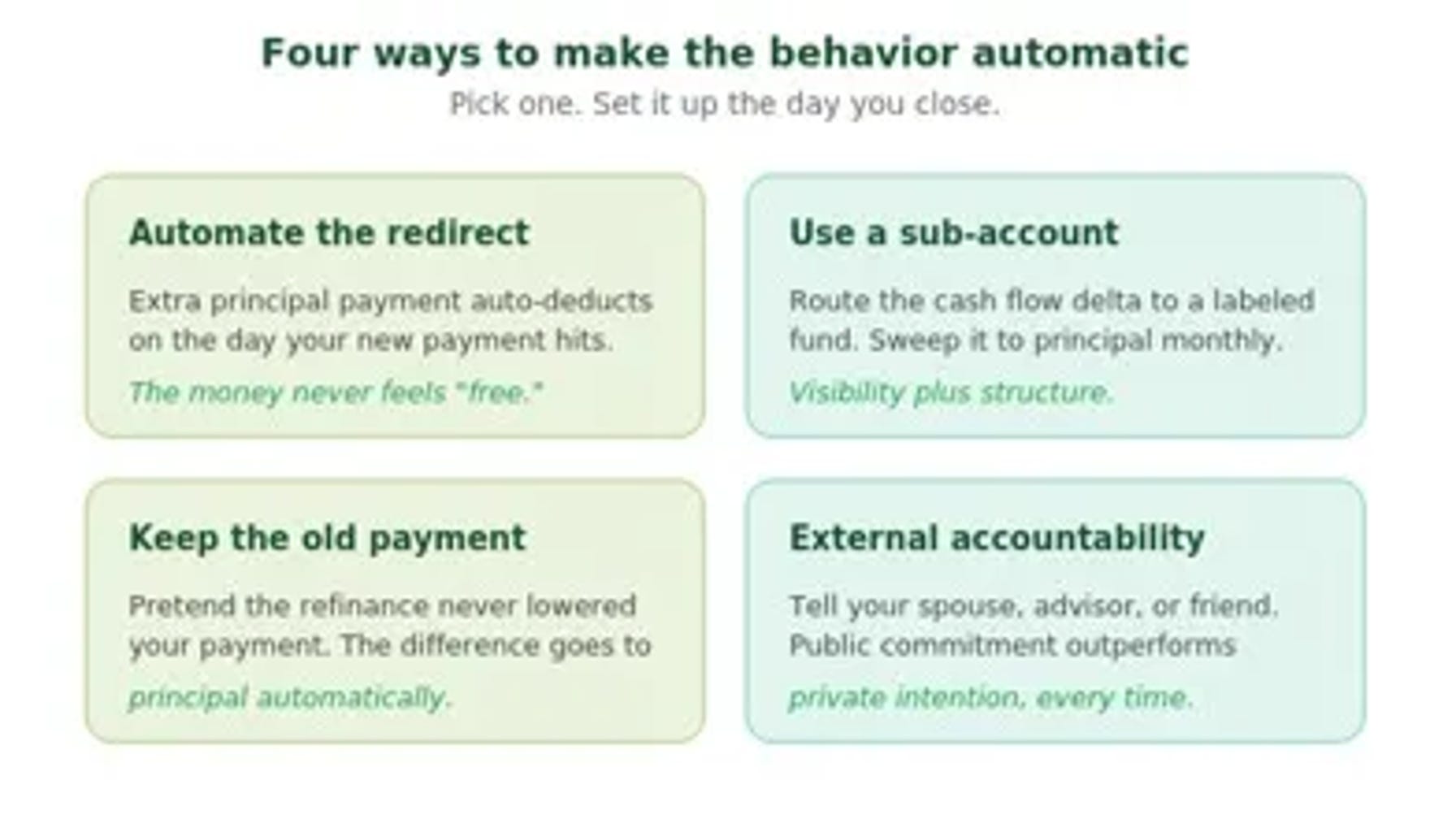
Automate the Redirect.
The single most powerful step. On the day your new lower mortgage payment goes into effect, set up an automatic additional principal payment for the exact amount of your cash flow relief. Most mortgage servicers allow this through their online portal. The money never touches your checking account as “free.” It moves from payroll directly to principal, bypassing the decision-making part of your brain that would otherwise spend it.
Automation beats willpower. Every time. Every study.
Use a Separate Sub-Account.
If your bank allows sub-accounts (many do), create one labeled something meaningful — “Principal Paydown” or “Wealth Fund.” Route the additional cash there automatically every payday. Once a month, sweep that account to principal. This approach works well for people who want visibility into the process but don’t trust themselves to make the transfer without a buffer step.
Treat the Old Payment as the Real Payment.
Mentally and financially, pretend the refinance never lowered your payment. Keep paying the old amount. The difference — the cash flow relief — goes to principal automatically. This reframing is surprisingly powerful because it removes the “I have extra money now” psychology entirely. You simply maintain the lifestyle you already had.
External Accountability.
Tell your spouse. Tell a financial advisor. Use a tool that tracks you. Share the plan out loud with someone whose opinion matters to you. Public commitment dramatically increases follow-through. Research in behavioral finance consistently shows that private commitments fail at much higher rates than public ones. Say it out loud to someone. Let them ask you about it in six months.
None of these require discipline in the moment. All of them pre-commit you to the behavior before your future self has a chance to negotiate.
The Guilt Trap — The Hidden Obstacle
Here’s where it gets harder to talk about, because the next obstacle isn’t mechanical. It’s psychological.
Many people who commit to redirecting cash flow to principal end up doing something strange: they start feeling guilty about every dollar they spend on anything. Dinner out starts to feel irresponsible. A weekend away feels indulgent. They tell themselves they’re being disciplined. In reality, they’re entering a scarcity mindset that will eventually break.
This matters because guilt-driven discipline isn’t really discipline. It’s suppression. And suppression collapses. People who beat themselves up over every purchase for 18 months often binge in month 19, undoing years of careful work.
There are four ways guilt undermines wealth-building, and each is worth understanding:
Guilt rewires the meaning of money. Money stops being a tool for building a good life and becomes a moral scorecard. Every purchase becomes a judgment. Every enjoyment becomes a failure. This is exhausting.
Guilt breaks the link between effort and reward. The entire point of discipline is to build a better life. If the discipline itself feels like punishment — and any reward feels like failure — then the brain learns a devastating lesson: building wealth means being miserable. Once that association forms, people unconsciously sabotage the effort.
Guilt often masquerades as values. Many people who feel guilty about spending tell themselves they’re being responsible or frugal. In reality, they’re often carrying inherited messages — from parents, from scarcity experiences in childhood — that equate enjoyment with irresponsibility. These aren’t values. They’re unprocessed programming. And they’re keeping people from actually enjoying the lives they’re building.
Guilt creates resentment in relationships. Partners feel the financial anxiety, even when it’s unspoken. Small hesitations over dinners and trips add up, even when said kindly. A household can be financially successful and emotionally depleted at the same time.
If any of this sounds familiar, I’d suggest a simple exercise. When you feel guilty about a planned reward or a reasonable purchase, ask yourself: Whose voice is telling me I shouldn’t? Is it a parent whose financial anxiety you absorbed? Is it a childhood experience of scarcity? Is it a cultural message that virtue equals sacrifice? None of those voices are necessarily wrong. But none of them are necessarily right for the life you’re living today. The question isn’t “should I spend this?” It’s “who decided I shouldn’t, and do I agree with them as an adult?”
Call it a Should Audit. It takes five minutes. It can dissolve guilt patterns that have been running in the background for decades.
The Reward Principle
Here’s the counterintuitive truth about building wealth sustainably: you have to reward yourself along the way, or you won’t sustain the behavior long enough to reach the goal.
This isn’t permission to be reckless. It’s recognition that humans don’t maintain behaviors that feel like punishment. If every dollar of wealth gain disappears into a bank account that you never enjoy, your brain eventually rebels. The discipline collapses. The reward principle prevents that collapse by building in earned celebration.
Here’s the rule I’ve come to believe in: when your disciplined behavior creates measurable wealth gain, commit 10% of that gain to an intentional reward.
If your redirected cash flow produces $3,000 in wealth gain over a year, take $300 and spend it deliberately. Not impulsively. A planned, earned celebration. A weekend trip. A nice dinner. A piece of equipment for a hobby you love. Something that says “I earned this.”
The percentage matters. Too small and it doesn’t feel like anything. Too large and it undoes the gain. Ten percent is the sweet spot — it reinforces the behavior that created the wealth without meaningfully diminishing the result.
A few guidelines for making this work:
• Experience-focused is better than material. Research on happiness consistently shows that experiences produce more lasting satisfaction than objects. A weekend with your family is remembered for years. A new gadget is forgotten in weeks.
• Planned, not reactive. The reward should be set in advance, not grabbed impulsively after a hard day. Intentionality is the difference between a reward and a consolation purchase.
• Mark the moment. Acknowledge what the reward represents. You earned this through disciplined behavior over twelve months. Let yourself feel that.
This is the structure that makes decades of wealth-building sustainable.
A Personal Reflection
A personal reflection, if you’ll allow one.
While writing this piece, I had to sit with something uncomfortable. The guilt trap I’ve been describing — I’ve lived in it. For much of my career, guilt has been quietly woven into how I think about money. Sometimes I might second-guess a weekend trip with my wife, or pause over a dinner out that was well within what we could afford. I told myself this was discipline. Looking back, I think it was closer to anxiety dressed up as virtue.
I suspect my wife has felt this more than I realized at the time. A small hesitation over a dinner reservation, or a gentle push-back on a weekend getaway — those things add up, even when they’re said kindly. I don’t think she ever doubted that I was trying to build something for us. But I wonder sometimes whether she felt, in quiet ways, that enjoying our life together had to be justified. That’s not what I ever wanted her to feel. I’m grateful every day for a wife who has been patient with me through all of it.
What’s changed is that I’ve started building intentional rewards into our life when we hit goals. Not lavish. Just real. A weekend away. A dinner that marks the moment. And if I’m being honest, now that I’m older — after many years of disciplined work — there are times we simply do what we want to do, because we’ve earned that too. At some point, you can relax into the life you’ve built. That’s not being reckless. It’s trusting that the foundation is solid, and letting yourself actually live on it.
I share this not because my life is a model, but because I suspect I’m not alone. If you’ve read this far and recognized yourself in the guilt section, I want you to know that recognition is the first step. And I’d love to hear your story too. If you’ve walked through any version of this — the guilt, the reframe, the slow learning to enjoy what you’ve built — I’d genuinely love to learn from your experience. Share it however feels right to you. The best insights I’ve had about money and life haven’t come from books. They’ve come from people willing to share honestly. I’m always listening.
The math is the math. But the relationship you have with the math — and with yourself, and with the people you love — is where wealth is actually built or quietly destroyed. I’m still learning this myself. I suspect I’ll be learning it for a long time.
The Education That Actually Helps
If any of what I’ve written resonates, the following books go deeper than a Substack article ever could. These aren’t casual recommendations. They’re the works I’ve seen transform how people relate to money and behavior.
Rich Dad Poor Dad by Robert Kiyosaki
The foundational text on the difference between assets and liabilities. Kiyosaki reshapes how you think about cash flow and what money is actually for.
The Total Money Makeover by Dave Ramsey
A disciplined, systematic framework for eliminating debt and building wealth. Behavioral commitment over clever math — directly aligned with what this article argues.
Money: Master the Game by Tony Robbins
Essential reading on the psychology of money. Robbins makes the case that building wealth you never enjoy is not mastery — it’s deprivation.
The Psychology of Money by Morgan Housel
If you only read one book on this list, read this one. The central argument — that financial outcomes depend far more on behavior than spreadsheets — is the intellectual foundation of everything I’ve written here.
Atomic Habits by James Clear
Not a finance book, but the best book on how to actually change behavior. If you’re worried you won’t follow through on redirecting cash flow to principal, this gives you the tools to make it stick.
The Millionaire Next Door by Thomas Stanley
Decades of research demonstrating that wealth is built by behavior, not income. A quiet masterpiece about ordinary people who made disciplined choices over long time horizons.
The Honest Close
A refinance is neither inherently good nor inherently bad. It’s a tool. What determines whether that tool builds wealth or destroys it is not the rate, not the closing costs, not even the amortization reset. It’s what you do with the cash flow relief it produces.
If you commit to redirecting that relief to principal, structure the commitment through automation and accountability, allow yourself earned rewards along the way, and release the guilt patterns that would otherwise undo the whole effort, a refinance can become a genuine wealth engine. Most borrowers never see this because most borrowers never do these things. But the math is available to anyone willing to do the behavior.
If you’re considering a refinance and you want to model both scenarios — the default case and the disciplined case — for your specific situation, reach out. I’ll run the numbers honestly. I’ll show you the default outcome, the disciplined outcome, and what it would take to bridge the gap. It takes about fifteen minutes. The decision affects decades.
About the Author
Gary Field is a Senior Loan Officer at NewFed Mortgage Corp focused on mortgage lending, behavioral finance, real estate decision-making, and the hidden math behind housing.
He serves buyers and homeowners across New Hampshire, Massachusetts, and Maine, with a particular focus on Southern New Hampshire.
Gary is the founder of Truth in Refi, a publication exploring mortgage psychology, housing market structure, affordability, refinancing, and financial decision-making.
truthinrefi.com
gary@truthinrefi.com
603-566-9346
NMLS #2738702 — Gary Field
NMLS #1881 — NewFed Mortgage Corp
NewFed Mortgage Corp is an Equal Housing Lender