
The New Hampshire Mortgage Market in April 2026: What Rising Inflation and Fed Uncertainty Mean for Southern New Hampshire Buyers

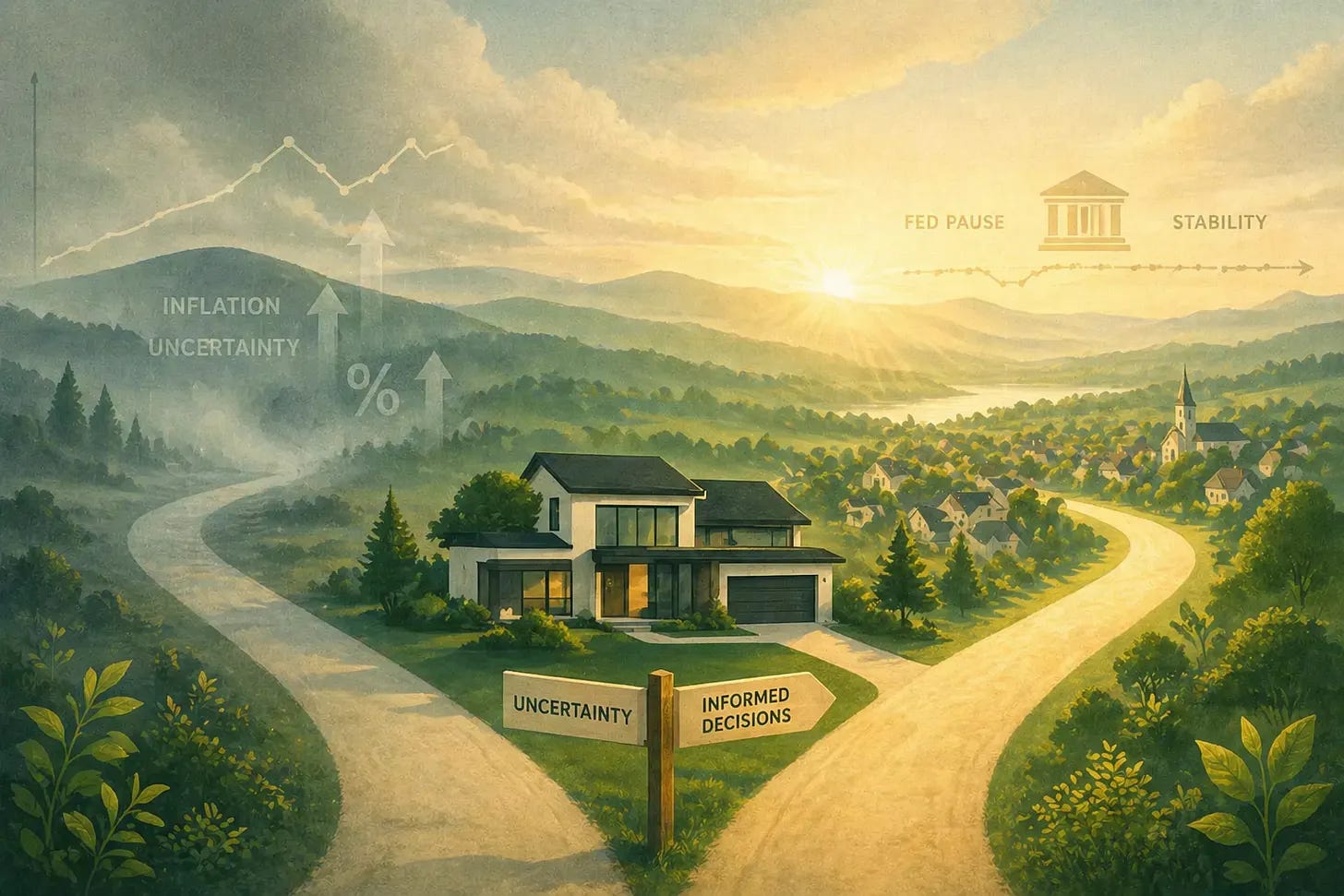
As we move through spring 2026, the mortgage landscape for homebuyers across Southern New Hampshire is shifting in ways that demand attention. If you’re considering a purchase in Manchester, Nashua, Bedford, Salem, Concord, or a surrounding area, understanding the current economic backdrop is essential to making a confident decision.
Current Mortgage Rates and Market Reality
As of April 2026, the 30-year fixed mortgage rate is holding steady around 6.41 to 6.46 percent, while 15-year mortgages are averaging 5.93 to 6.02 percent. These rates have proven resilient over recent weeks, neither dramatically rising nor falling, which tells us the market is in a holding pattern as investors and lenders wait for clarity from Washington and the Federal Reserve.
Inflation: The Elephant in the Room
Here’s where things get interesting. Inflation expectations for 2026 have shifted. In March, the Organization for Economic Cooperation and Development raised its forecast for U.S. inflation to 4.2 percent for the full year, a significant jump from their prior estimate of 2.8 percent. This matters to mortgage borrowers because inflation directly influences the Federal Reserve’s decisions on interest rates.
The culprits driving this revision are varied — ongoing tariff effects, geopolitical tensions including the recent conflict in Iran, and stronger-than-expected economic growth. These factors create upward pressure on prices and, consequently, on what the Fed might do next.
What the Federal Reserve Is Signaling
The Fed currently holds its target rate in the 3.5 to 3.75 percent range. After cutting rates three times in late 2025, the Fed has paused, holding steady through early 2026. Most Fed officials now forecast only one additional rate cut by year-end 2026, bringing the target range to 3.25 to 3.50 percent.
The uncertainty, however, is real. The Fed’s own projections show core inflation ending 2026 at 2.7 percent — higher than their preferred two percent target. If inflation proves stickier than expected, rate cuts could be delayed or cancelled entirely. Conversely, if economic growth weakens, the Fed might cut more aggressively.
For mortgage borrowers, this means rates could drift modestly higher or hold steady throughout 2026. The days of consistent rate declines are likely behind us.
The Southern New Hampshire Housing Market: A Tale of Two Forces
Southern New Hampshire’s real estate market is displaying remarkable resilience, even as affordability pressures mount.
In Manchester, the largest city in your service area, the median home price sits around 415,000 to 448,000 dollars, depending on the specific neighborhood. Homes are moving quickly — typically selling in around 7 to 32 days depending on condition and price point — and multiple offers remain common. Year-over-year price appreciation in Manchester has been modest by recent standards, around 2 to 4 percent, suggesting the market is stabilizing after years of explosive growth.
Nashua and the greater Manchester-Nashua corridor remain highly competitive. Properties here sell at or above list price regularly, with inventory sitting at just 1.4 months of supply statewide — well below the 6-month supply considered a balanced market.
Bedford and Salem, as suburban communities closer to Manchester, continue to attract families seeking good schools and commuter access. These towns benefit from New Hampshire’s lack of state income tax and sales tax, a significant draw for relocating families from Massachusetts and other high-tax states.
Concord, sitting a bit further north, offers a different dynamic. As the state capital, it provides more modest entry-level pricing whilst maintaining steady appreciation. The Concord market forecasts growth around 1.6 percent through 2026, reflecting a more measured pace than the Manchester-Nashua corridor.
Overall, across Southern New Hampshire, median home prices have reached 484,000 to 535,000 dollars depending on location and property type. Affordability remains strained — the statewide affordability index sits at 59, meaning a household needs substantially more than the median income to qualify for the median-priced home.
What This Means for First-Time Homebuyers
If you’re a first-time buyer in Manchester, Nashua, Bedford, Salem, or Concord, here’s the practical takeaway: rates are unlikely to fall dramatically in the near term. Waiting for a quarter-point or half-point rate drop could mean missing out on a home whilst prices continue their steady march upward. The math often favors acting now rather than delaying.
Additionally, building your credit profile and accumulating down payment savings over the next three to six months positions you far better than waiting for market conditions that may never materialize. The first-time buyer advantage — whether FHA, VA, or conventional financing — remains substantial. And there are NH housing programs available also. Private mortgage insurance, whilst an additional cost, is manageable when structured properly within your overall financial picture.
The Bottom Line
April 2026 presents a moment of stability in an uncertain economic environment. Mortgage rates are holding, the Fed is on pause, inflation pressures are real but not yet runaway, and Southern New Hampshire’s housing markets remain competitive but more rational than in recent years.
Your best move isn’t to time the market perfectly — it’s to understand your own financial goals, get properly positioned financially, and make a decision aligned with your life plans rather than rate predictions. That’s where genuine confidence in homeownership begins.
If you’re in Southern New Hampshire and thinking about your next move — whether buying, refinancing, or exploring reverse mortgage options — I’m here to walk you through the process with clarity and expertise.
Know someone buying or selling a home this year? Forward this to them. The market is moving quickly.
About the Author
Gary Field is a Senior Loan Officer at NewFed Mortgage Corp focused on mortgage lending, behavioral finance, real estate decision-making, and the hidden math behind housing.
He serves buyers and homeowners across New Hampshire, Massachusetts, and Maine, with a particular focus on Southern New Hampshire.
Gary is the founder of Truth in Refi, a publication exploring mortgage psychology, housing market structure, affordability, refinancing, and financial decision-making.
truthinrefi.com
gary@truthinrefi.com
603-566-9346
NMLS #2738702 — Gary Field
NMLS #1881 — NewFed Mortgage Corp
NewFed Mortgage Corp is an Equal Housing Lender
Great article Gary!
Love it, Gary!
Great post