
DSCR and Asset Depletion Loans: The Quiet Rise of Mortgages Without a W-2
How DSCR loans and asset depletion mortgages are reshaping who qualifies in 2026, built on a federal carve-out most borrowers have never heard of.

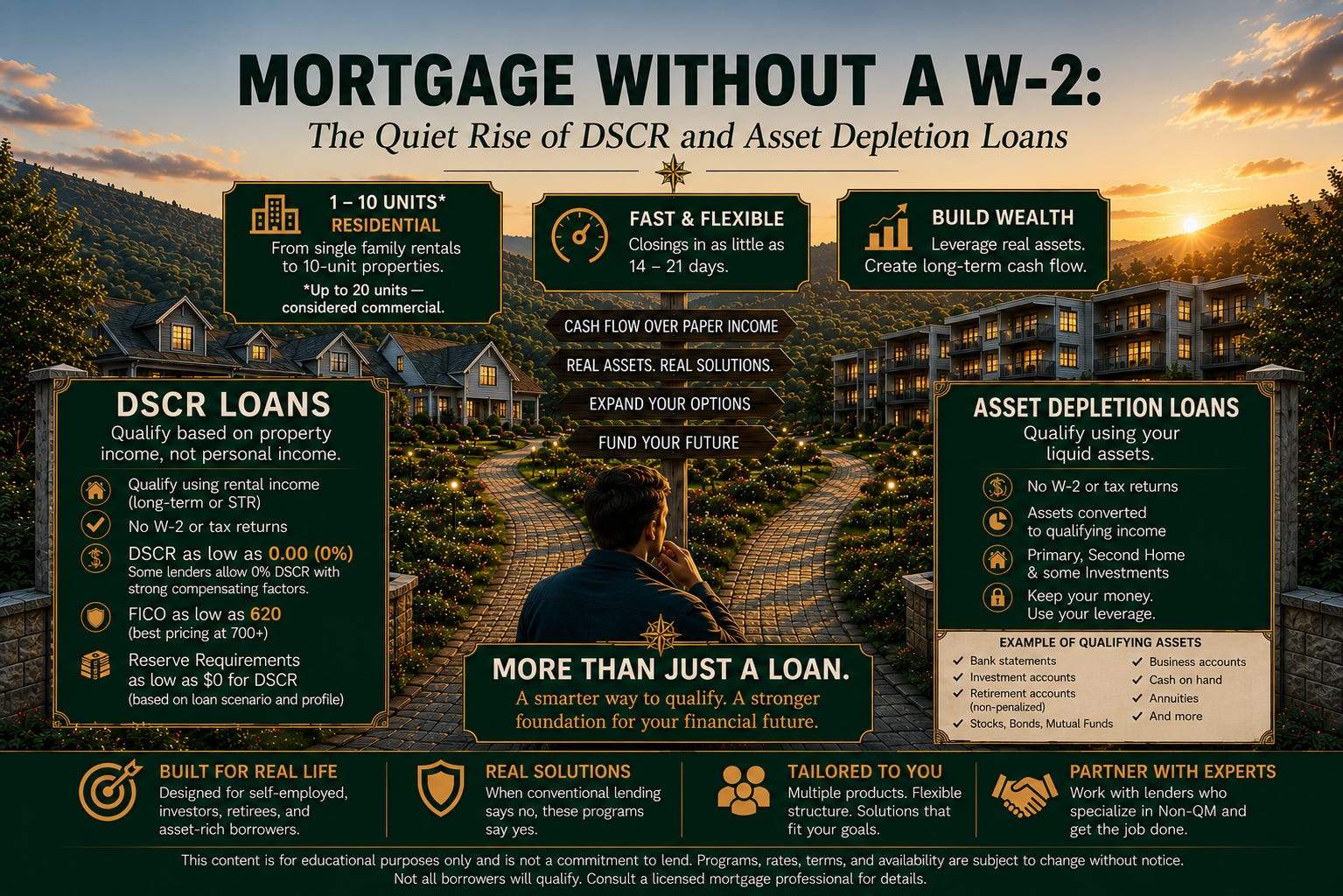
Here are two common borrower situations I see in my practice.
The first owns four rental properties and is looking to add a fifth, a non-warrantable condo cash-flowing 18% better than the others. His W-2 income from his day job is modest, his tax returns show aggressive depreciation, and his debt-to-income ratio on paper makes him untouchable to every conventional lender.
The second is 72 years old. Sold a business in 2023. Sitting on $2.4 million across brokerage and IRA accounts. Wants to buy a single-story home closer to her grandchildren. Her Social Security check and small required minimum distribution wouldn’t qualify her for a $400,000 mortgage at any agency lender.
Both can close.
Neither uses a W-2. Neither uses a tax return. Neither qualifies through the channels most homebuyers assume are the only channels.
This is happening more often than people realize, and the two products behind it, DSCR (debt-service coverage ratio) loans and asset depletion loans, are growing faster than almost any other category in residential lending. If you write off these borrowers because conventional financing won’t work, you’re misreading where the market actually is in 2026.
TL;DR: DSCR loans (debt-service coverage ratio) qualify real estate investors based on a property's rental income, not personal income. Asset depletion mortgages qualify retirees and high-net-worth borrowers based on their liquid assets, not W-2 income. Both are growing fast in 2026, both exist because of an explicit federal regulatory carve-out, and both are dramatically underused by borrowers who assume conventional financing is their only option.
Why this matters now
Real estate investors purchased between 33% and 34% of all single-family homes sold in the United States in 2025, the highest investor share in five years, according to BatchData's Investor Pulse Reports. These are typically individuals scaling rental portfolios, often hitting the conventional limit of 10 financed properties or running into the income-documentation wall that comes with owning multiple LLCs. At the same time, on January 1, 2026, the oldest baby boomers turned 80. The generation that holds more than half of all U.S. household wealth is reaching the age where they’re downsizing, relocating, or repositioning real estate for legacy planning, and almost none of them earn a W-2.
Both groups had a problem. The market built two solutions. Non-QM securitization hit a record high in 2025, and DSCR loans alone represented roughly 30% of that volume, according to HousingWire. This isn’t a niche anymore. It’s a structural shift.
I wrote earlier this year about the quiet ways purchase transactions fall apart. A surprising number of them have nothing to do with the property. They fall apart in the income documentation phase, when the borrower’s tax returns, business structure, or non-traditional income simply can’t be forced into the conventional underwriting box. DSCR and asset depletion exist precisely because those borrowers were never broken. The product was.
DSCR loans: when the property pays its own way
A DSCR loan (debt-service coverage ratio) qualifies a borrower based on the income produced by the property being financed, not the income of the borrower personally.
The math is straightforward:
DSCR = Gross Monthly Rent ÷ PITIA (Principal + Interest + Taxes + Insurance + HOA/Assessments)
A ratio of 1.0 means the property’s rent exactly covers its monthly carrying costs. Most lenders look for 1.20 or higher, which gives a cushion for vacancy and maintenance. Some programs will lend at sub-1.0 with pricing adjustments.
The trade-off is documentation, not rigor:
This product solves problems conventional lending can’t touch:
I’ve written separately about how condo financing has quietly gotten stricter. DSCR is often the only viable path for non-warrantable buildings that agencies will no longer touch.
The math isn’t difficult. The product isn’t exotic. What’s exotic is that most borrowers, and a surprising number of agents and loan officers, still don’t know it exists.
Asset depletion loans: when wealth is the income
The retired business owner with $2.4 million? She would use an asset depletion mortgage.
An asset depletion loan converts a borrower’s eligible liquid assets into a hypothetical monthly income stream. The lender doesn’t ask the borrower to actually spend down the assets. They’re used as a mathematical proxy for income capacity.
A typical depletion calculation:
(Eligible Assets − Down Payment − Closing Costs − Required Reserves) ÷ Depletion Period (in months) = Monthly Qualifying Income
Lenders use different depletion periods. Some at 60 months, others at 84, 120, or 240. Different formulas produce very different qualifying numbers, which is why one lender will tell a retiree she doesn’t qualify while another will close her loan the same week. The mechanics matter.
What counts as eligible assets, and at what percentage, also varies:
Checking, savings, money market, CDs: typically 100% of balance
Stocks, bonds, mutual funds: typically 70-80%
Retirement accounts (IRA, 401(k)): typically 60-80%, with steeper discounts for borrowers under 59½
Example: how the math actually works
Take the 72-year-old retiree from the opening. She has $2.4 million split evenly between a brokerage account and an IRA, and she’s targeting a $500,000 home with 20% down. Here’s how a lender would typically run the calculation on a 120-month depletion period:
That’s roughly $161,000 in annualized qualifying income against an approximately $3,300/month housing payment. The retiree whose Social Security alone would have failed at every agency lender qualifies cleanly.
Two things worth noticing:
She never actually spends the assets. They stay in her accounts. The math is just a proxy for income capacity.
A lender using a 60-month period would have generated $26,866/month. A 240-month lender would have generated $6,716/month. Same borrower, same assets, dramatically different qualifying income. The methodology is the whole game.
The product is built for four borrower profiles:
Retirees with substantial portfolios and modest documented income
Business owners who recently sold their company and are holding the proceeds
Self-employed owners whose tax returns understate their true financial picture
High-net-worth individuals who simply don’t have a W-2 lifestyle
None of them are broken borrowers. They’re profitable customers the agency box refuses to acknowledge.
The math here matters in a way that connects directly to my earlier post on the Amortization Trap. Small differences in lender methodology produce dramatically different qualifying outcomes, the same way small differences in refinance assumptions produce dramatically different net economic gains. In both cases, the borrower who doesn’t run the math themselves gets whatever number the loan officer hands them. That’s a bad trade.
The federal regulation that made both possible
These products exist because of an explicit carve-out in federal law that most articles skip.
After the 2008 housing crisis, the Dodd-Frank Act of 2010 directed the CFPB to write the Ability-to-Repay/Qualified Mortgage (ATR/QM) Rule, codified at 12 CFR §1026.43, which requires lenders to make a “reasonable, good faith determination” that a borrower can repay a residential mortgage. Two carve-outs in this rule do the heavy lifting:
Business-purpose loans are exempt from ATR. When a DSCR loan is properly structured as a business-purpose transaction, typically held in an LLC on an investment property, it falls outside Regulation Z’s ATR requirements entirely. Not a loophole. An explicit statutory exclusion.
Non-QM loans satisfy ATR through alternative documentation. Asset depletion loans must still verify ability to repay, but the rule doesn’t dictate how. Assets converted into qualifying income, properly documented, satisfy the standard.
The CFPB’s own ATR/QM rule page covers the regulatory detail. The practical takeaway: federal law deliberately left room for lenders to qualify borrowers outside the W-2 standard, as long as underwriting is responsible.
Who underwrites these types of loans
Both products require lenders who actually know the underwriting. That’s a smaller list than most people realize. The mainstream agency lenders most borrowers are familiar with don’t offer them, or offer them only as token products buried under overlays.
For non-QM files, I often prefer to work with HomeXpress Mortgage, a wholesale lender that specializes in DSCR, bank statement, and asset-based programs. HomeXpress was recognized as a 2026 Top Workplace by Scotsman Guide, the industry’s gold-standard ranking authority, and they’ve been one of the more consistent non-QM shops I work with for files that don’t fit the agency box.
My account executive at HomeXpress is Laurie Souza-Cratty. Laurie is top notch, one of the best in the industry. Based in Greater Boston, she’s a National Wholesale AE with 25+ years of experience specifically in non-QM and business-purpose DSCR financing. The proximity matters less than the expertise. These products live and die on underwriting nuance, and an AE who knows the program overlays cold is the difference between a clean closing and a torpedoed deal.
I mention this for two reasons. First, transparency. If you read my work and reach out about a DSCR or asset depletion file, you should know who’s behind the loan. Second, the lender genuinely matters in non-QM. It’s not unusual for the same mortgage application, submitted to two different wholesale lenders, to produce very different results. One may approve the file while the other denies it.
The behavioral piece most articles miss
I write often about the fact that behavior tends to beat math in real-world finance. The rational choice on a spreadsheet often loses to what people actually do. DSCR and asset depletion are unusual because they invert that pattern.
These products require borrowers to do something most don’t want to do: stop assuming conventional mortgages are the only option. The retiree who’s been told “you don’t have enough income to qualify” believes that statement because the loan officer she spoke to genuinely meant it, within the conventional box that loan officer works in. The investor who’s been told he’s maxed out on conventional financing thinks he’s done growing because his current loan officer doesn’t have access to DSCR programs.
The behavior to change isn’t financial. It’s about what you’re willing to believe.
Borrowers have to be willing to believe that the answer they got might not be the only answer available. That’s harder than it sounds, especially for borrowers who’ve been told no by an institution they trust.
If you have substantial assets but limited documented income, or you own rental properties and have been told you don’t qualify for another conventional loan, or you’ve been told flat out that you can’t qualify, you may have been working with a lender whose product mix doesn’t fit your situation.
A practical offer
If any part of this matches your situation (a retiree wondering whether your assets can support a mortgage, an investor who’s been told they can’t qualify for another conventional loan, or a self-employed borrower whose tax returns make conventional underwriting impossible), I’ll run the math for you at no cost. Send me the rough numbers (asset balances or projected rental income, your estimated loan amount, credit score range) and I’ll give you a straight answer on whether DSCR or asset depletion should be considered, and what kind of pricing to expect.
That’s not a sales pitch. It’s the analysis I’d want if I were on your side of the table.
Truth In Refi is Free
I write about the math and psychology behind mortgage and real estate decisions, the things most buyers, sellers, and agents don’t get told until it’s too late. Subscribe to get the next piece in your inbox the moment it publishes. Free to read, free to subscribe, and easy to unsubscribe if it’s not for you.
Frequently Asked Questions
What is a DSCR loan? A DSCR (debt-service coverage ratio) loan qualifies a real estate investor based on the rental income produced by the property being financed, not the borrower’s personal income. No W-2s, tax returns, or pay stubs are required. The property’s rent must cover its monthly carrying costs, typically by a ratio of 1.20 or higher.
What is an asset depletion mortgage? An asset depletion mortgage qualifies a borrower by converting their eligible liquid assets (brokerage accounts, retirement accounts, savings) into a hypothetical monthly income stream. The borrower doesn’t spend down the assets. The math is just a proxy for income capacity, designed for retirees, business sellers, and high-net-worth borrowers without traditional W-2 income.
Can retirees qualify for a mortgage without W-2 income? Yes. Asset depletion mortgages are specifically designed for retirees with substantial portfolios but modest documented income. A 72-year-old with $2.4 million in liquid assets can qualify for a $400,000 mortgage cleanly, even when their Social Security and required minimum distributions wouldn’t meet conventional debt-to-income standards.
What credit score is required for a DSCR loan? Most DSCR lenders require a minimum FICO score of 620, with best pricing typically available at 700 or above. Down payment requirements are usually 20 to 25 percent, and lenders typically want 6 to 12 months of PITIA reserves, but some scenarios don’t require reserves.
About the Author
Gary Field is a Senior Loan Officer at NewFed Mortgage Corp.
He is a mortgage originator serving New Hampshire, with a focus on Southern New Hampshire, MA, and ME with expertise in conventional loans, FHA, VA, non-QM loans, first-time homebuyer programs, and reverse mortgages.
For more borrower-side analysis of the mortgage and real estate market, visit truthinrefi.com.
Gary lives in Manchester, NH and maintains an office at 234 Sutton Street, North Andover, MA 01845.
Reach Gary at his office: 603-566-9346 or gfield@newfed.com
Gary Field, NMLS #2738702 NewFed Mortgage Corp, NMLS #1881 NewFed Mortgage Corp is an Equal Housing Lender