
Rate Buydowns: Why the Cheaper Payment Isn't Saving You
Temporary vs. permanent mortgage rate buydowns explained. The math, psychology, and hidden tradeoffs many buyers miss. Run the numbers before you sign.

Bottom line:
Temporary buydowns (2-1 or 3-2-1 escrow) reward buyers expecting short ownership or strong refinance odds. Permanent buydowns (discount points) reward buyers planning to stay put.
The biggest mistake is qualifying yourself to the discounted Year 1 payment instead of the fully indexed payment you’ll actually pay later.
Before you commit to either, ask: How long will I really keep this loan? Could this money do more elsewhere (PMI elimination, debt paydown, reserves)? Can I comfortably afford the full note-rate payment from day one?
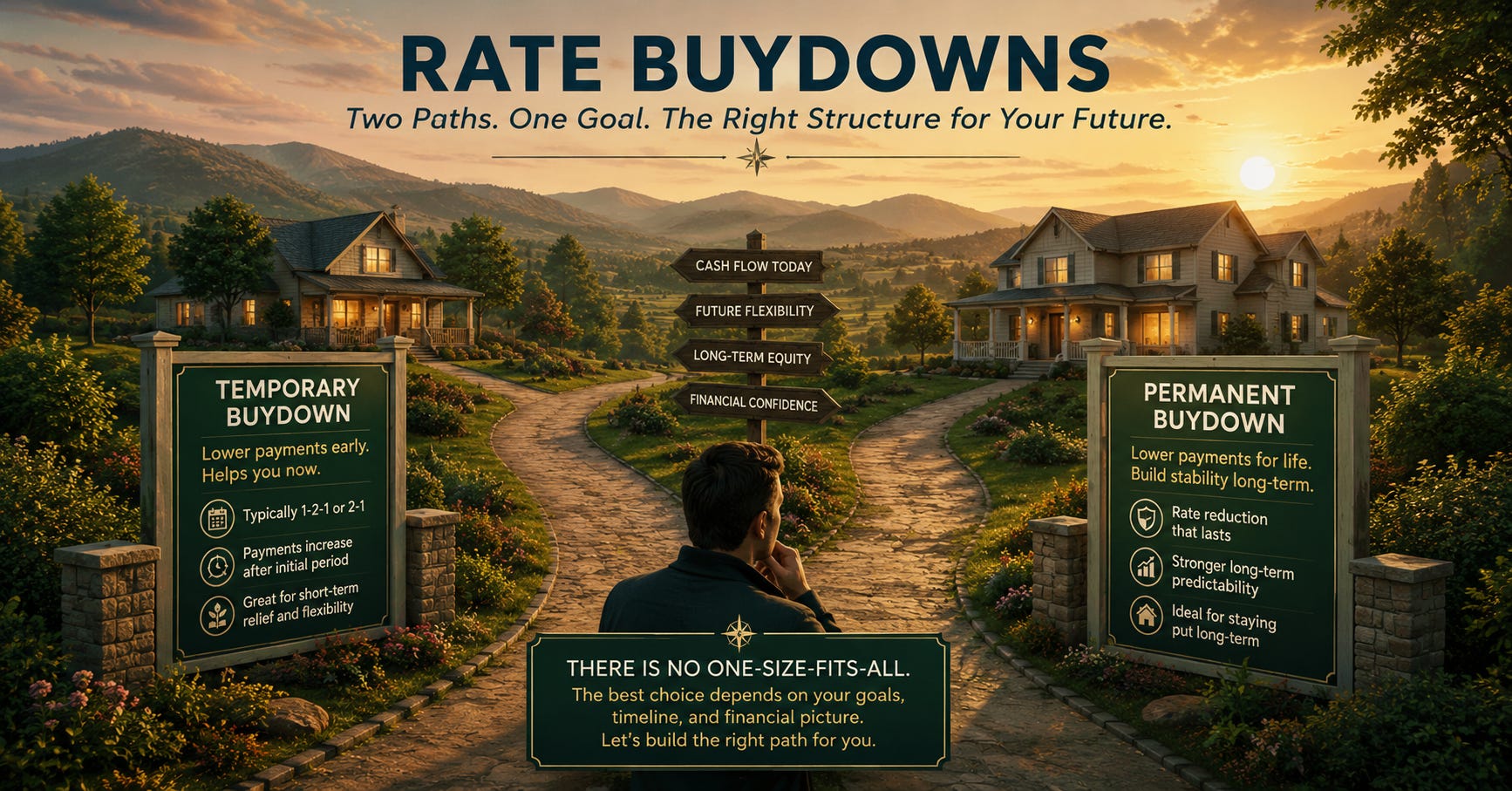
Two paths, one decision. Temporary buydowns trade upfront cost for short-term payment relief. Permanent buydowns trade upfront cost for long-term rate reduction. Which path makes sense depends entirely on the life you’re likely to live with the mortgage.
A buyer sits at the kitchen table late at night staring at three loan estimates open on a laptop while texting their Realtor and trying to make sense of advice coming from three different directions.
One lender says paying points for a permanent rate buydown is the “smart long-term move.” A builder’s preferred lender is heavily promoting a 2-1 temporary buydown. A friend insists rates will fall within a year anyway and says paying for any buydown is a mistake.
The buyer isn’t trying to outsmart the bond market. They’re trying to answer a much more ordinary question:
Which option actually makes sense for the life I’m likely to live?
That’s where rate buydown conversations become surprisingly complicated. Because the uncomfortable truth is that there often isn’t a universally correct answer.
Rate buydowns sit at the intersection of mathematics, psychology, inflation expectations, refinancing probability, and human behavior. And in today’s market, they’ve quietly become one of the most misunderstood parts of residential lending.
A rate buydown is not inherently good or bad. It’s a bet. The question is whether the borrower understands what they’re actually betting on.
The Two Completely Different Things People Call “Rate Buydowns”
One reason this topic confuses buyers is that the phrase “rate buydown” gets used to describe two very different strategies.
A permanent buydown means paying upfront fees, often called discount points, to permanently reduce the mortgage interest rate for the life of the loan.
A temporary buydown works differently. The note rate remains unchanged, but funds are placed into an escrow account to temporarily subsidize part of the borrower’s monthly payment during the early years of the mortgage.
The most common temporary structure in today’s market is the 2-1 buydown.
On a 2-1 buydown:
Year 1 payment is calculated at 2% below the note rate
Year 2 payment is calculated at 1% below the note rate
Year 3 onward returns to the full note rate
The actual note rate never changes. That distinction matters enormously, because psychologically, many borrowers experience temporary buydowns as “lower rates,” when in reality they are simply receiving temporary payment assistance funded upfront, often by the seller.
A temporary buydown changes your early cash flow. A permanent buydown changes the economics of the loan itself.
That difference becomes especially important once you start thinking about refinancing.
Why Temporary Rate Buydowns Suddenly Became Popular Again
For much of the ultra-low-rate era, temporary buydowns were relatively uncommon. When rates sat near 3%, sellers didn’t need to create affordability incentives. Homes sold quickly, bidding wars were common, and buyers had little leverage to negotiate concessions.
Once mortgage rates moved sharply higher after 2022, affordability changed dramatically. Monthly payments exploded. At the same time, many sellers became psychologically anchored to pandemic-era pricing expectations and resisted meaningful price reductions.
Temporary buydowns emerged as a compromise. Instead of lowering the purchase price by $10,000 or $15,000, a seller could contribute a smaller amount toward a temporary payment reduction that made the home feel more affordable during the first one or two years.
That structure gained enormous popularity in 2023 through 2025, particularly on:
New construction homes
Builder inventory
Higher-priced suburban properties
Markets where sellers needed payment relief to attract buyers
Builders especially embraced temporary buydowns because they allowed them to preserve headline pricing while improving monthly affordability. Fannie Mae's guidelines on temporary buydowns recognize the role these structures play in concession-based financing, and in many markets today, a meaningful percentage of financed transactions involve some type of concession-based temporary buydown structure..
The Psychological Problem Hidden Inside Temporary Rate Buydowns
Temporary buydowns create a behavioral finance problem that doesn’t get discussed enough: people normalize payment levels surprisingly quickly.
A borrower who becomes emotionally comfortable with a Year 1 payment based on a 4.875% effective rate may psychologically struggle when the payment resets higher — even though the increase was fully disclosed from the beginning. The math was always visible. The emotional adaptation wasn’t.
This becomes especially dangerous if the borrower quietly assumes: “I’ll just refinance before the payment adjusts.”
Maybe they will. But refinancing depends on future interest rates, future property values, employment stability, credit profile changes, and loan qualification standards that may not look the same two years from now.
A temporary buydown works best when the borrower can comfortably afford the fully indexed payment from the very beginning. The temporary buydown should function as breathing room, not survival.
The biggest risk in a temporary buydown is not the structure itself. It’s borrowers emotionally underwriting themselves to the discounted payment instead of the real one.
Permanent Rate Buydowns Are Purely Math
Permanent buydowns are emotionally simpler. You pay upfront money to permanently lower the interest rate. The key question becomes whether the savings generated by the lower rate exceed the upfront cost within the period you actually keep the mortgage.
That’s the breakeven calculation. A surprisingly useful approximation looks like this:
The exact math changes constantly with market pricing. But conceptually, permanent buydowns become more attractive when:
Loan balances are larger
Interest rates are higher
The borrower expects to keep the mortgage longer
Refinancing probability appears lower
And less attractive when:
Rates appear likely to decline materially
The borrower may move soon
The upfront cash could solve a more important financial problem elsewhere
That last point gets overlooked constantly. A borrower paying PMI, carrying revolving debt, or maintaining weak emergency reserves may not always be best served by spending thousands of dollars chasing a slightly lower interest rate.
Sometimes using those funds to reduce the loan amount, eliminate PMI faster, strengthen reserves, or reduce higher-interest debt creates a healthier overall financial structure than purchasing a lower mortgage rate.
The Seller Concession Question Nobody Asks Correctly
One of the most interesting strategic questions in today’s market is whether seller concessions are better spent on temporary buydowns, permanent buydowns, or direct price reductions.
The answer depends heavily on borrower psychology and expected loan duration.
A permanent price reduction lowers principal balance, monthly payment, future interest costs, and sometimes PMI exposure. And importantly, those benefits continue permanently.
A temporary buydown creates larger short-term payment relief but no long-term reduction in loan balance. That’s why temporary buydowns often work best when the buyer has temporary short-term cash flow pressure, expects near-term income growth, or values early payment flexibility while still comfortably qualifying at the fully indexed payment.
But there’s an important nuance here that gets missed constantly. If a borrower genuinely expects to refinance very soon because they strongly believe rates will decline materially, the question isn’t whether to use a temporary buydown — it’s who’s paying for it.
If the seller is funding the buydown, accepting it is usually fine. The borrower gets early payment relief, and at refinance, the unused subsidy gets credited to the new loan as a principal reduction. Effectively a windfall.
If the borrower would be funding it themselves, the math gets uncomfortable. They pay upfront for a benefit they only partially use, then recover the unused portion as a principal credit at refinance. Not a total loss, but rarely worth the upfront cash. In that scenario, the smarter move is usually taking the standard loan structure, preserving liquidity, reducing principal balance, or negotiating a direct price reduction instead.
Meanwhile, permanent buydowns work better for borrowers expecting long holding periods and stable long-term ownership. But psychologically, many buyers overweight immediate payment relief and underweight long-term balance reduction.
People feel monthly payments emotionally. They experience principal balances abstractly. That psychological asymmetry influences a tremendous amount of mortgage decision-making.
Rate Buydowns vs. PMI: An Underrated Comparison
One of the more overlooked comparisons in mortgage planning is whether funds spent on a temporary buydown might create greater value if redirected toward reducing PMI exposure instead.
Suppose a borrower has a conventional loan with monthly PMI, moderate cash reserves, and seller concessions available. The borrower might instinctively pursue a temporary buydown because the lower payment feels attractive.
But in some situations, directing those same funds toward reducing the loan balance enough to lower PMI, shorten PMI duration, or eliminate PMI entirely can produce stronger long-term economics — especially because PMI elimination creates a permanent monthly improvement instead of a temporary one.
The right answer depends heavily on expected ownership duration, refinancing expectations, loan size, and household cash flow resilience. This is why “best loan program” conversations often fail. The mathematically optimal structure depends heavily on the borrower’s future behavior.
Which Rate Buydowns Work Best in Different Rate Environments?
This table is obviously simplified — nobody knows future rates with certainty. But conceptually:
Temporary buydowns implicitly assume refinancing probability may improve later
Permanent buydowns assume the borrower may keep the loan structure much longer
That’s why permanent buydowns tend to become more attractive during higher-rate environments where borrowers believe rates may remain elevated for extended periods.
And ironically, this is also why many borrowers misjudge them. When rates are high, buyers psychologically resist paying additional upfront costs because the environment already feels expensive. But mathematically, high-rate environments are often precisely when permanent buydowns become more powerful.
What Rate Buydowns Are Really About
The most sophisticated mortgage conversations are usually not really about rates. They’re about flexibility.
A borrower stretching financially to purchase a home may value temporary cash flow relief enormously, even if the long-term math isn’t ideal. A highly stable borrower with strong reserves and long ownership expectations may rationally prefer permanent payment reduction. Another borrower may benefit most from reducing leverage altogether.
This is why intelligent mortgage planning increasingly looks less like product selection and more like systems analysis. The “best” structure depends on future mobility, career stability, inflation expectations, emotional payment tolerance, reserves, refinancing probability, and behavioral discipline.
Mortgage structures don’t exist in isolation. They exist inside people’s lives. And the borrowers who tend to make the strongest long-term decisions are usually not the people chasing the lowest initial payment. They’re the people who understand how the structure behaves after ordinary life starts happening.
A Quick Rate Buydown Cheat Sheet
The best mortgage structure is usually not the one that creates the lowest payment today. It’s the one that creates the healthiest long-term financial behavior.
Frequently Asked Questions
What’s the difference between a temporary and permanent rate buydown? A temporary buydown lowers your monthly payment for a fixed period (typically 1–3 years) using money placed in an escrow account, often funded by the seller. The note rate on your loan never changes. A permanent buydown means paying discount points upfront to permanently lower the interest rate for the entire life of the loan.
How does a 2-1 buydown work? With a 2-1 buydown, your payment in Year 1 is calculated as if your rate were 2% lower than the actual note rate. In Year 2, the payment is calculated as if your rate were 1% lower. From Year 3 onward, you pay the full note-rate payment. The note rate itself never changes — only the early-year payments are subsidized from an escrow account.
Is paying discount points for a permanent buydown worth it? It depends on how long you keep the loan. As a rough rule, 1 point costs about 1% of the loan amount and reduces the rate by approximately 0.25%. Breakeven is usually 4–7 years. If you’ll keep the loan past breakeven, the buydown saves money. If you refinance or sell before then, you’ve paid for a benefit you didn’t use.
Should I use seller concessions for a buydown or a price reduction? A price reduction lowers your principal balance permanently, reducing your payment, total interest, and sometimes PMI. A temporary buydown gives larger short-term payment relief but no long-term balance reduction. If you expect to stay long-term and have stable cash flow, a price reduction often wins. If you need early payment relief and qualify comfortably at the full payment, a temporary buydown can make sense.
Can I refinance out of a temporary buydown? Yes, and the mechanics are more borrower-friendly than most people realize. The tax-and-insurance escrow side is usually a non-event — new escrows typically get rolled into the refinanced loan amount, and your old escrow refund arrives 30–60 days after closing. As for the buydown subsidy escrow itself, the unused portion almost always gets applied as a principal-reduction credit to your new loan. The catch: if the seller funded the buydown, that credit is essentially a windfall. If you funded the buydown yourself, you’re recovering money you already spent — and you paid for a benefit you only partially used. The takeaway: if strong refinance expectations are central to your plan, accepting a seller-funded buydown is usually fine, but funding one yourself rarely earns its keep.
What if I can’t afford the fully indexed payment after my temporary buydown expires? This is the biggest risk in a temporary buydown. Lenders qualify you at the full note-rate payment for exactly this reason — to confirm you can afford the loan after the subsidy ends. If you’re stretching to afford even the discounted Year 1 payment, a temporary buydown is the wrong structure for your situation.
If you’re considering a refinance and would like me to model buydowns for your specific situation, reach out. I’ll run the numbers.
About the Author
Gary Field is a Senior Loan Officer at NewFed Mortgage Corp.
He is a mortgage originator serving New Hampshire, with a focus on Southern New Hampshire, MA, and ME with expertise in conventional loans, FHA, VA, non-QM loans, first-time homebuyer programs, and reverse mortgages.
For more borrower-side analysis of the mortgage and real estate market, visit truthinrefi.com.
Gary lives in Manchester, NH and maintains an office at 234 Sutton Street, North Andover, MA 01845.
Reach Gary at his office: 603-566-9346 or gfield@newfed.com Or you may reach him at: gary@truthinrefi.com
Gary Field, NMLS #2738702 NewFed Mortgage Corp, NMLS #1881 NewFed Mortgage Corp is an Equal Housing Lender