
PMI vs MIP: One Ends Automatically. One Usually Doesn’t
A first-time homebuyer’s guide to PMI vs MIP: how each is removed, what it costs long-term, and how to compare FHA against conventional before you choose

Bottom line: PMI on conventional loans ends automatically at 78% LTV. MIP on FHA loans usually does not. That single structural difference matters more over thirty years than any interest rate gap a lender will quote you. The cheaper monthly cost on day one is not the cheaper cost over the life of the loan.
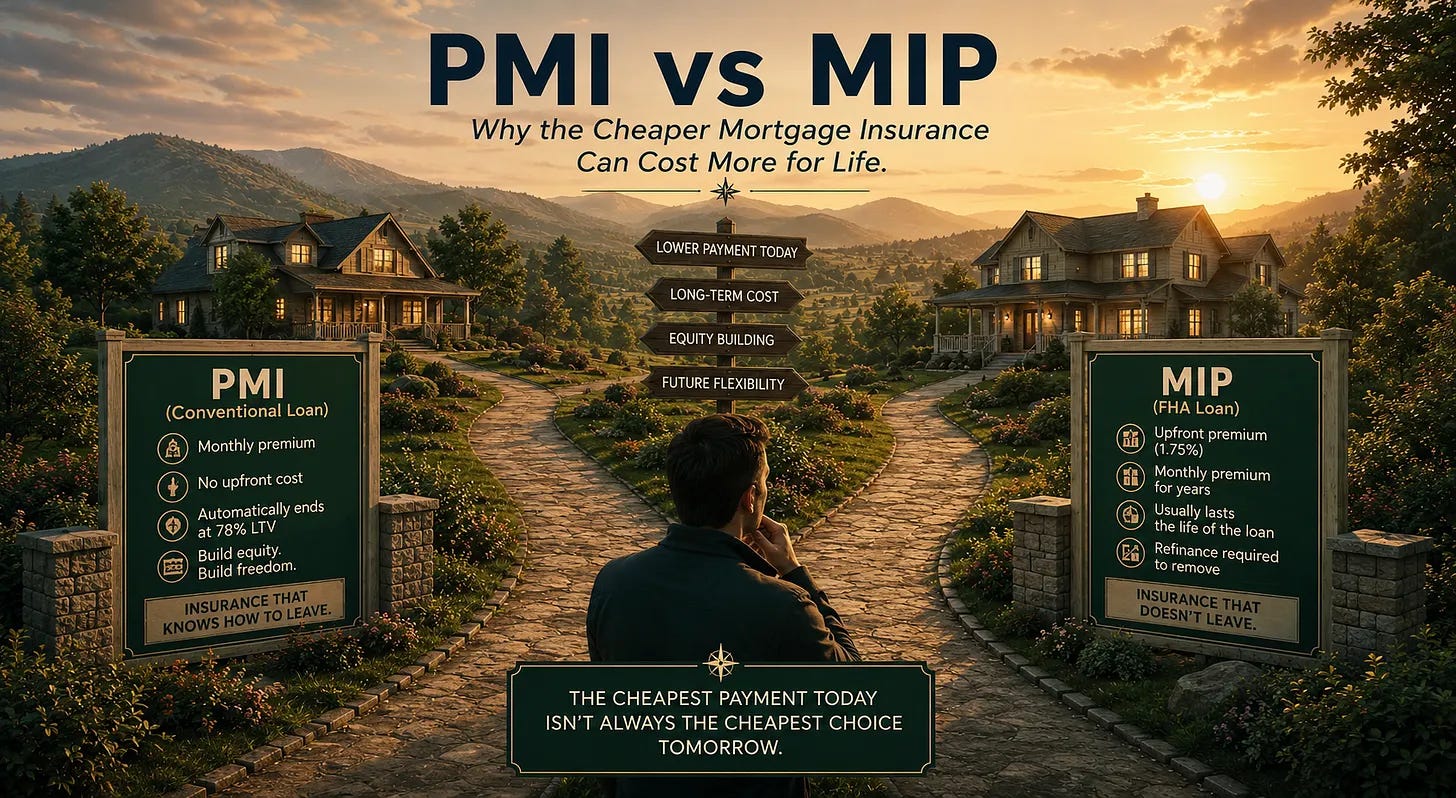
Every few weeks a borrower sends me two loan estimates and asks me to settle an argument they’re having with themselves. One is FHA, one is conventional. The FHA payment is lower. Sometimes by a little, sometimes by real money. And the question is always some version of the same thing: why would I pick the more expensive one?
It’s a fair question with an uncomfortable answer. The cheaper payment on that FHA estimate often isn’t cheaper at all — not over the years they’ll actually own the home. The gap hides in a single line item most people skim past: mortgage insurance. One version of it ends on its own. The other usually doesn’t, and getting out of it costs a refinance most borrowers never budget for.
Mortgage insurance is the most misunderstood line on a loan estimate. Borrowers see two products with similar names, similar monthly costs, and similar functions, and reasonably assume they’re interchangeable. The PMI vs MIP decision comes down to one structural difference: PMI ends. MIP usually doesn’t.
Conventional private mortgage insurance ends automatically once a borrower builds enough equity. FHA mortgage insurance, in most cases, doesn’t. One product has a built-in exit. The other requires a refinance to escape. That single structural difference can mean tens of thousands of dollars over the life of a loan, even when the monthly costs look identical on paper.
The cheaper insurance on day one is not always the cheaper insurance over thirty years.
What’s Actually Being Insured
Mortgage insurance is not for the borrower. That sentence catches most buyers off guard, but it is the foundation of everything else.
Private Mortgage Insurance (PMI) and Mortgage Insurance Premium (MIP) both pay the lender if the borrower defaults. The borrower writes the check every month. The lender keeps the protection. The buyer carries the cost and the risk.
Both products cover the same basic risk. A loan with less than 20% down is statistically more likely to end in default. The insurance covers the lender for the top portion of that exposure, typically the difference between what was lent and what could be recovered in a foreclosure sale. Lenders treat it as a way to make low-down-payment loans without absorbing market downturns themselves.
The difference between PMI and MIP is not what they insure. It is who runs the policy, how much it costs, and when it ends.
Mortgage insurance is not insurance the borrower carries. It is insurance the borrower pays for, and the lender collects on.
PMI: The Insurance That Knows How to Leave
Private Mortgage Insurance applies to conventional loans with less than 20% down. The premium is monthly only. There is no upfront fee.
Cost ranges from roughly 0.30% to 1.15% of the loan amount per year, depending heavily on credit score and down payment size. Borrowers with strong credit and 10% to 15% down often see PMI around 0.4% per year. Borrowers with weaker credit and 5% down can see PMI cross 1% per year. On a $400,000 loan, that is a swing of $200 per month or more, entirely driven by credit profile.
The structural advantage of PMI is its exit ramp. The federal Homeowners Protection Act of 1998 created clear rules. A borrower can request cancellation when the loan-to-value ratio reaches 80% based on the original purchase price. Cancellation becomes automatic at 78% LTV based on the original amortization schedule. If neither trigger fires, PMI must terminate at the loan’s midpoint regardless. PMI has a built-in expiration date.
That single difference is where the long-term math separates from the monthly comparison.
PMI is the only mortgage insurance with a built-in exit. Every other variant requires a refinance to escape.
MIP: The Insurance That Doesn’t Leave
FHA loans require Mortgage Insurance Premium regardless of down payment size. The structure has two parts.
The upfront premium, called UFMIP, is 1.75% of the base loan amount (current FHA premium schedule). Almost every FHA borrower finances it into the loan rather than paying it at closing. On a $400,000 purchase with 3.5% down, that adds roughly $6,755 to the loan balance on day one. The borrower pays interest on that amount for as long as the loan exists.
The annual premium for most 30-year FHA borrowers in 2026 is 0.55%, paid monthly. That was reduced from 0.85% in February 2023, the most significant FHA insurance change in over a decade. On the same $400,000 loan, annual MIP costs about $183 per month.
The painful part is the duration. For loans originated after June 3, 2013 with less than 10% down, MIP lasts the full life of the loan. There is no 80% LTV trigger. There is no automatic cancellation. The only path out is to refinance the entire mortgage into a conventional loan, which means closing costs, a new rate, and a reset amortization schedule (see The Amortization Trap for why that reset is more expensive than most borrowers realize).
Borrowers who put 10% or more down get MIP relief after 11 years, which sounds like a meaningful concession until you compare it to conventional. A borrower with 10% down and strong credit can usually qualify conventionally, where PMI ends automatically at 78% LTV (often in 5 to 8 years). The 11-year FHA exit is most valuable to borrowers who have the down payment but lack the credit or debt profile to qualify conventionally.
FHA MIP is not a temporary cost. It is a permanent feature of the loan, unless the borrower pays again to remove it.
The Comparison Table
Side-by-side at the five common loan-to-value points, for a borrower with mid-range credit:
A note on the 97.75% row. FHA’s lowest down payment is 3.5%, which produces a 96.5% base loan-to-value. Once the upfront MIP of 1.75% gets financed into the loan, the effective LTV climbs above 97%. The 97.75% figure is where many FHA loans actually start life on day one.
The pattern most buyers notice first: at high LTVs, FHA monthly cost looks lower than conventional, especially for borrowers with weaker credit. That impression is honest at the top of the table and incomplete at the bottom. The conventional borrower has an exit. The FHA borrower does not.
The Choice Isn’t About the Monthly Number
The real comparison happens over time, and three variables drive it.
Credit score matters more than buyers think. PMI pricing is credit-sensitive. A 640 FICO borrower at 95% LTV often pays close to 1.15% in PMI, roughly double FHA MIP at the same down payment. For that borrower, FHA is genuinely cheaper even after factoring in UFMIP. A 760 FICO borrower at the same LTV pays 0.55% to 0.65% PMI, comparable to MIP but without the lifetime cost. The same loan amount and the same down payment can produce different right answers based on credit alone.
Time horizon matters more than rate. A buyer who plans to sell or refinance within five years barely notices the lifetime-MIP issue. The FHA loan ends before MIP matters. A buyer planning to stay fifteen to thirty years carries MIP for the full term unless they refinance, which itself triggers closing costs and an amortization reset.
The exit ramp is the asset. Conventional borrowers reach 80% LTV through some combination of principal paydown and home appreciation, at which point PMI ends without cost. FHA borrowers reach the same equity threshold and still pay MIP every month. The conventional exit ramp is free. The FHA exit ramp is a refinance.
The right mortgage insurance choice is the one whose exit ramp matches the life you actually plan to live.
The Buydown Wrinkle
Many sellers in 2026 are offering concessions in the form of rate buydowns rather than price cuts. That intersects with mortgage insurance in ways borrowers rarely think through.
Buydowns work on both conventional and FHA loans, in both permanent (discount points) and temporary (2-1 or 3-2-1 escrow) flavors (how temporary and permanent buydowns actually differ). Sellers can fund either type on either program, subject to concession caps that generally run 3% to 6% of purchase price depending on the program and down payment.
The relevant question is whether the buydown is helping you keep a loan you would otherwise want to escape. A seller-funded permanent buydown on a conventional loan lowers your rate for life, and you still hit the 80% LTV PMI cancellation trigger on schedule. A seller-funded permanent buydown on an FHA loan lowers your rate for life, but MIP keeps running. The buydown’s value depends on how long you actually keep the loan, and on an FHA loan, the math has to assume you may refinance later anyway to escape MIP. A buydown locked to a loan you will refinance is a partial waste of the concession.
Temporary buydowns add another layer. A 2-1 buydown on an FHA loan lowers your payment for two years while MIP still applies. If you refinance to conventional during those two years to escape MIP, the unused buydown subsidy credits back to your loan balance, but you also pay closing costs for the refinance. The buydown helped cash flow briefly. The MIP escape cost real money.
What This Is Really About
The choice between FHA and conventional in 2026 is not a choice between two interest rates or two mortgage insurance premiums. It is a choice between two exit ramps.
Conventional financing builds a free exit into every loan. As equity accumulates through payments and appreciation, PMI ends without a refinance. The borrower keeps the rate, keeps the amortization progress, and simply stops paying for insurance. FHA financing does not work that way. The exit costs something.
Ask your loan officer about your exit, not your entry. Get a clear answer on when your mortgage insurance ends and what removing it requires. If the answer involves a refinance, factor in the cost, the rate environment you will face, and the equity you will reset.
The behavioral angle matters too. Most buyers anchor on the cheapest monthly number and ignore the long tail (a pattern I wrote about in Behavior Beats Math). The right loan program is rarely the one with the lowest payment on day one. It is the one whose lifecycle matches the life you plan to live in the home.
Frequently Asked Questions
Does PMI go away automatically? Yes. Under the Homeowners Protection Act of 1998, PMI cancels automatically once your loan balance hits 78% of the home’s original value, based on the original amortization schedule. You can also request cancellation yourself at 80% LTV.
Can you remove FHA MIP without refinancing? Usually not. For FHA loans with a case number assigned on or after June 3, 2013 and less than 10% down, MIP runs for the life of the loan. The only way out is to refinance into a conventional loan. Borrowers who put down 10% or more get MIP removed after 11 years.
Is PMI or MIP cheaper? It depends entirely on credit score. A borrower with weaker credit (say, 640 FICO) at 95% LTV can pay close to 1.15% in PMI annually — nearly double FHA’s 0.55% MIP rate. A borrower with strong credit (760+) often pays PMI in the 0.55%–0.65% range, comparable to MIP, but with an automatic exit MIP doesn’t offer.
CTA
If you would like a side-by-side analysis on your specific situation, get in touch. I will run both scenarios honestly, including the long-term path. The decision lasts decades. The conversation takes about fifteen minutes.
Know a first-time buyer comparing FHA and conventional offers right now? Or a Realtor whose clients keep asking about mortgage insurance? Forward this to them. The choice between PMI and MIP is quieter than it should be, and it shows up in real money long after the closing table.
About the Author
Gary Field is a Senior Loan Officer at NewFed Mortgage Corp and a REALTOR® in New Hampshire focused on mortgage lending, behavioral finance, real estate decision-making, and the hidden math behind housing.
He serves buyers and homeowners across New Hampshire, Massachusetts, and Maine, with a particular focus on Southern New Hampshire.
Gary is the founder of Truth in Refi, a publication exploring mortgage psychology, housing market structure, affordability, refinancing, and financial decision-making.
truthinrefi.com · gary@truthinrefi.com · 603-566-9346
NMLS #2738702 — Gary Field, NMLS #1881 — NewFed Mortgage Corp. NewFed Mortgage Corp is an Equal Housing Lender.
Very good article.