
Mortgage Rates 2026: Why Expected Cuts Got Less Likely
Mortgage rates didn’t fall as expected in 2026. The Fed’s dot plot flipped to a coin flip on hikes. Here’s what it means for Manchester and NH buyers

I suspect there are Southern New Hampshire buyers who paused their search back in March. Rates had just touched 6.09%, the lowest in three years, and every headline said the same thing: more cuts were coming. Why lock in now when waiting might save you a quarter point?
It’s July. If those buyers exist, they’re still waiting, and mortgage rates haven’t fallen further. As of the first week of July, the 30-year fixed is averaging 6.43%, up from that 6.09% low in February, and the Fed’s own committee is now split down the middle on whether the next move is up or down. Nobody, including the Fed, is claiming to know. Waiting on a narrative that was reasonable in March and hasn’t held up since isn’t a mistake so much as it’s a failure to update. That gap between “what I decided” and “what actually happened” is where this piece lives.
What Actually Happened, In Plain English
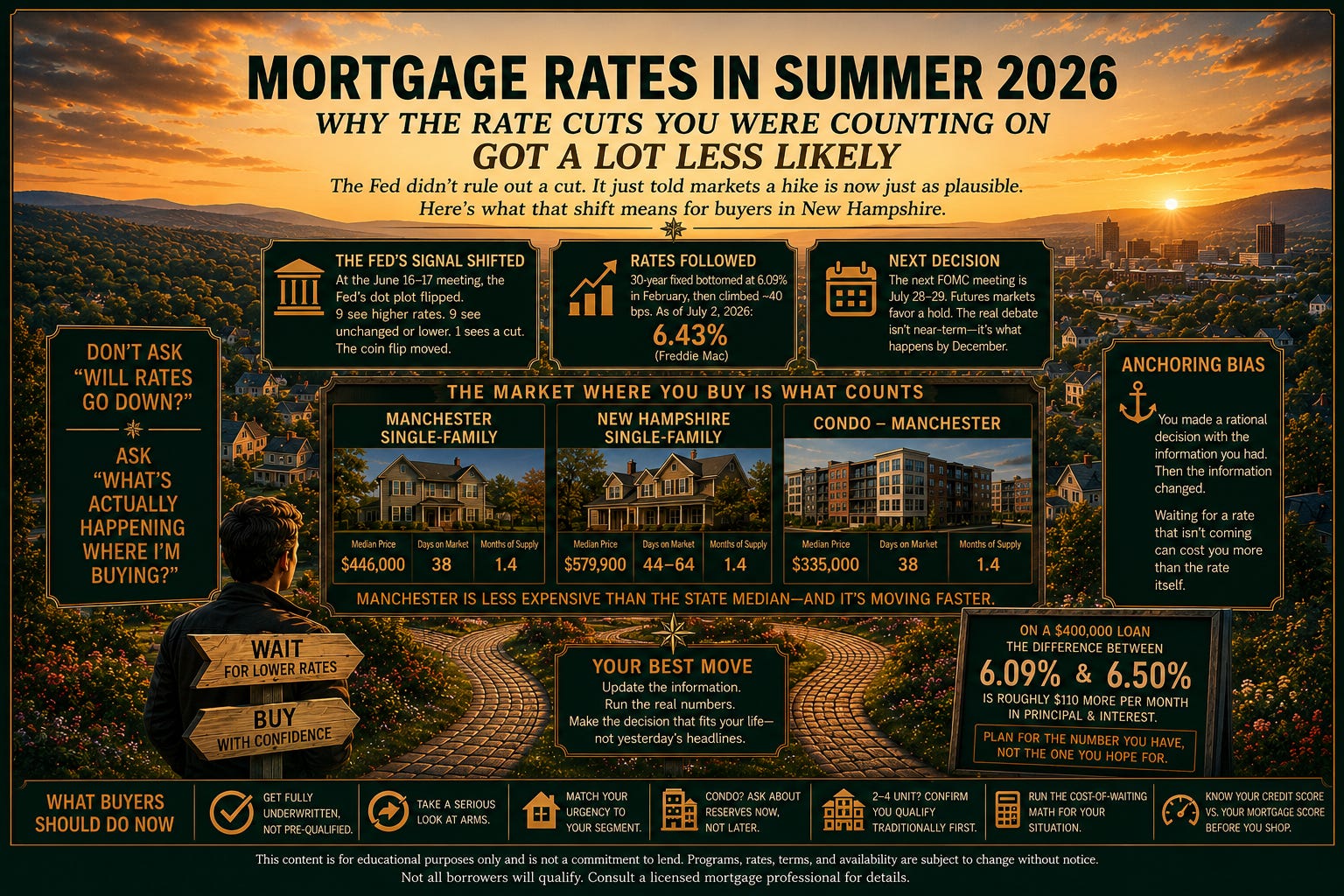
After cutting rates three times in the back half of 2025, the Federal Reserve held its benchmark rate at 3.50%-3.75% through the first half of 2026. That was expected. What wasn’t expected: at the June 16-17 meeting, the Fed’s dot plot flipped from a median projection of one quarter-point cut by year-end to a median implying essentially none. Of the 18 policymakers who submitted projections, nine now see rates ending the year higher and nine see them unchanged or lower. One lone dot still sees a cut. That’s not the Fed declaring cuts dead. It’s the Fed telling you the coin flip moved from “probably a cut” to “genuinely uncertain, with real odds it goes the other way.” Inflation running hotter than the Fed’s 2% target is the reason why.
Mortgage rates follow that signal closely. The 30-year fixed bottomed near 6.09% in mid-February, then climbed roughly 40 basis points over the following months. As of Freddie Mac’s most recent weekly survey (July 2, 2026), the 30-year fixed averaged 6.43%. Other daily trackers had it closer to 6.5%-6.6% the same week. The exact number moves day to day, but the direction is consistent: up, not down, from where most buyers assumed it would be by summer.
The next FOMC meeting is July 28-29. As of early July, CME FedWatch was pricing a hold at that meeting as the overwhelming favorite, with the real debate centered on what happens by December, not on any near-term cut arriving to rescue buyers who’ve been waiting since spring.
Don’t Ask “Will Rates Go Down.” Ask “What’s Actually Happening Where I’m Buying.”
National rate headlines flatten three very different markets, single-family, condo, and 2-4 unit multi-family, into one number, and they flatten “New Hampshire” into a single data point that neither Manchester nor the surrounding county actually reflects.
A buyer deciding whether to move now or wait needs to know what’s happening in their specific segment and their specific geography, not what the national average is doing.
The Numbers, Layered
National vs. New Hampshire vs. Manchester (single-family and condo)
Manchester is less expensive than the state median, and it’s moving faster. That’s the opposite of what a “market is cooling” headline implies if you don’t separate city from state.
Hillsborough County, 2-4 unit multi-family
This is where the data gets thinner, and I’d rather tell you that than dress up a soft number. At the Manchester-city level, monthly 2-4 unit sale counts are too small to report a median price with a straight face. At the Hillsborough County level, the sample is workable: roughly 60 multi-family units were on the market at a given point this spring, with median list prices around $560,000 and typical time on market in the 29-day range. That’s asking price on active inventory, not closed comps. Treat it as a temperature check on demand, not a precision figure.
The takeaway that survives the caveat: multi-family inventory in the county is thin and moving fast, which tracks with what I’m seeing on the DSCR side of my own pipeline (see: Post 8, on DSCR and asset depletion loans).
The Behavioral Piece: Anchoring
A buyer who did this in March didn’t make an irrational decision. They made a rational decision based on the information available, then failed to update it when the information changed. That’s anchoring bias: the tendency to over-weight the first number or narrative you encounter and keep measuring everything against it, even after it’s stale.
I’ve written before about how behavior, not math, usually decides the outcome of a financial decision (see: Post 3, Behavior Beats Math). This is the same mechanism working in the opposite direction. In that piece, the risk was spending savings you didn’t notice you had. Here, the risk is waiting for a number that isn’t coming back, while carrying costs (rent, a rate that could still move against you, a market where the specific house you wanted sells to someone else) accumulate in the background.
Here’s the simple math worth sitting with: on a $400,000 loan, the difference between 6.09% and 6.5% is roughly $110 a month in principal and interest. That’s real, but it’s a number you can plan around. What isn’t easy to plan around is the house that sold in the 38 days you spent waiting for a rate that hasn’t materialized.
For Buyers: What To Do With This
Get fully underwritten, not pre-qualified. With rates moving 15-20 basis points in a week, a stale pre-qual can misstate what you actually carry.
Take a casual look at ARMs before ruling them out. With the 30-year fixed sitting in the mid-6% range and short-term rates still elevated, a 5/1 or 7/1 ARM may or may not pencil out depending on how long you plan to stay in the property. Worth 15 minutes with your loan officer, not a default dismissal.
Match your urgency to your segment. If you’re shopping single-family in Manchester specifically, 1.4 months of supply and 38-day DOM means the “wait for it to cool off” strategy is working against you, not for you. If you’re shopping the $500K-$900K range in the wider region, you genuinely have more room to negotiate.
If it’s a condo, ask about the reserve fund now, not after you’ve fallen in love with the unit (see: Post 6, on the 2027 condo financing changes).
If it’s a 2-4 unit, confirm you actually qualify traditionally first. Conventional financing is less expensive than DSCR whenever you qualify on it. DSCR is the fallback for when your tax returns, DTI, or income documentation won’t work, not the default starting point. Know which bucket you’re in before you shop, not after you find the property.
Run the actual cost-of-waiting math for your situation rather than reacting to the next headline (see: Post 11, Should I Buy a House Now or Wait?).
Read up on how your credit score translates to your actual mortgage pricing before you shop rates. The two aren’t the same number, and the gap between them affects what rate you actually qualify for (see: Post 9, Your Credit Score and Your Mortgage Score Are Not the Same Number).
For Agents: What To Tell Clients Before They Get Surprised
Retire the single-market script. Manchester single-family, statewide single-family, and county multi-family are behaving differently right now. A client who hears “the market is cooling” from a national outlet and then loses a multiple-offer situation on a Manchester starter home will blame you, not the headline.
Set rate expectations explicitly, before the client falls for a listing. A buyer who assumed cuts were coming and got a hike signal instead is a buyer who feels misled, even if you never said rates would fall.
For condo listings, get the reserve study and funding percentage before you list. An accepted offer that collapses in underwriting three weeks in costs you the listing’s momentum and often the next-best buyer.
For multi-family listings, know your buyer pool splits between owner-occupants and DSCR-qualified investors, and that changes your marketing and your contingency conversations.
Don’t let “supply is up” become the whole story. Supply is up year-over-year almost everywhere in the data above, and it’s still historically tight almost everywhere in the data above. Both things are true at once. Say both.
Frequently Asked Questions
Will mortgage rates go down in 2026? Maybe, but it’s no longer the safer bet. The Fed’s June dot plot showed policymakers evenly split, nine expecting higher rates by year-end, nine expecting unchanged or lower, with only one lone dot still projecting a cut. Treat a rate drop as possible, not planned.
What is a good mortgage rate right now? As of Freddie Mac’s July 2, 2026 survey, the 30-year fixed averaged 6.43% nationally. “Good” depends on your credit profile, loan size, and points paid, so that number is a benchmark to compare quotes against, not a target every borrower will get.
Should I wait for rates to drop before buying? That depends far more on your segment and geography than on the national rate headline. In Manchester, single-family inventory is tight enough (1.4 months of supply, 38-day average time on market) that waiting on rates could cost you the property before it saves you the rate. Run the actual math for your situation before deciding either way.
If You Want This Run For Your Specific Situation
Everything above is directional. None of it tells you what your specific rate lock, your specific segment, or your specific timeline should look like, because that depends on numbers I don’t have yet. If you want me to run the actual math for a purchase or refinance you’re considering, reach out. I’ll show you the real numbers, not the headline version.
About the Author
Gary Field is a Senior Loan Officer at NewFed Mortgage Corp and a REALTOR® in New Hampshire focused on mortgage lending, behavioral finance, real estate decision-making, and the hidden math behind housing.
He serves buyers and homeowners across New Hampshire, Massachusetts, and Maine, with a particular focus on Southern New Hampshire.
Gary is the founder of Truth in Refi, a publication exploring mortgage psychology, housing market structure, affordability, refinancing, and financial decision-making.
truthinrefi.com · gary@truthinrefi.com · 603-566-9346
NMLS #2738702 — Gary Field, NMLS #1881 — NewFed Mortgage Corp. NewFed Mortgage Corp is an Equal Housing Lender.
Gary Field writes TruthInRefi, a newsletter on the mechanics and psychology behind mortgages and real estate decisions, at truthinrefi.com. He works with buyers, sellers, and agents across New Hampshire, Massachusetts, and Maine.