
Should I Buy a House Now or Wait? An Honest Framework for the 2026 Market
The right answer isn’t whether home prices keep climbing. It’s how long you’ll stay, what you can comfortably carry, and whether you’ve done the homework before you fall in love with a listing

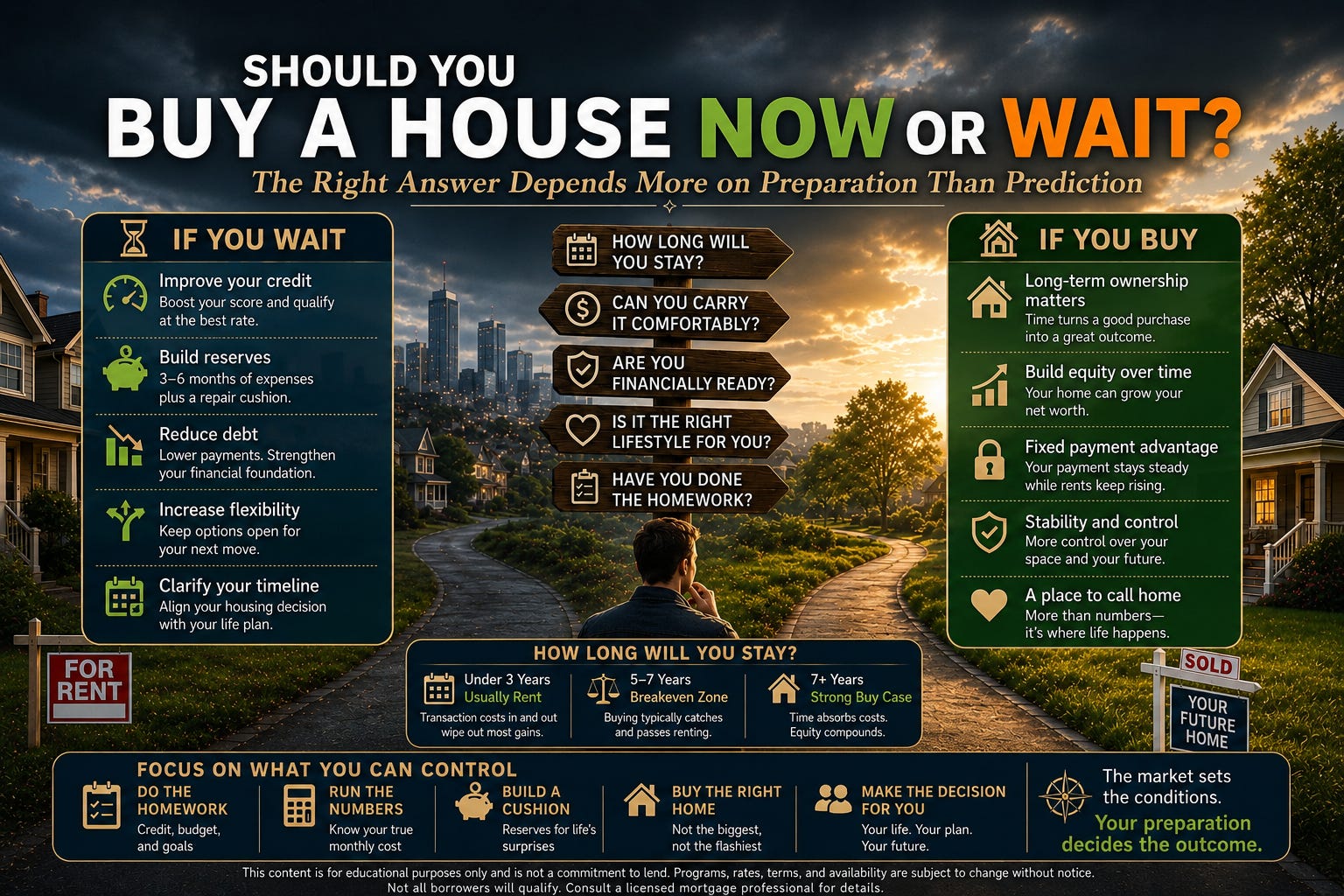
I’ve watched buyers here in southern New Hampshire walk away from homes they wanted, not because the deal fell apart, but because the headlines made them wonder whether waiting would be smarter. The math said buy. The fear said wait. The fear won.
So let me give you the honest answer up front, because most articles dance around whether you should buy a house now or wait: there is no universal “now” or “wait.” Buying is the right move for some people in 2026 and the wrong move for others, and the deciding factors have very little to do with predicting where prices go next. They have to do with your timeline, your income stability, your debt, your reserves, and whether you’ve prepared. This piece walks through each one so you can decide for your situation, not the market’s.
If you’re an agent, this is the article to forward to the client who keeps asking “what would you do?” It gives them a framework instead of a guess.
TL;DR: Whether you should buy a house now or wait in 2026 has almost nothing to do with predicting prices and almost everything to do with you: how long you’ll stay (five-plus years tilts strongly toward buying), whether you can carry the payment through a rough patch, and whether you’ve done the credit, budget, and reserve homework before you fall for a listing. Rates are in the mid-6s. Prices are at records. Prepared buyers tend to do fine in any market. Unprepared ones carry real risk in the same market.
Should you buy a house now or wait? Start with the real question
Most people walk into this decision asking: Will real estate keep going up?
That’s the wrong question, and it’s wrong for a simple reason: nobody knows, and your financial outcome barely depends on the answer anyway. Markets that look obvious in hindsight are a coin flip in the moment.
The better question, the one that actually predicts whether buying works out for you, is this:
Will I stay in this home long enough, and carry it comfortably enough, that short-term price moves stop mattering?
That shift in thinking changes everything. A home you hold for ten years through a stable career is a fundamentally different financial instrument than the same home sold in eighteen months because the job moved or the budget got tight. Same house. Same price. Completely different outcome. The variable isn’t the market. It’s you.
What the 2026 housing market actually looks like
A quick, honest briefing, because you can’t make a good decision on vibes.
Rates are in the mid-6s. As of mid-June 2026, the 30-year fixed averaged 6.52 percent, per Freddie Mac’s weekly survey, down from roughly 6.84 percent a year ago. Here’s the part worth remembering: the rate slipped to about 6.35 percent in late May, then climbed back to 6.52 percent within weeks as the conflict with Iran pushed oil prices and inflation expectations higher. Anyone who saw that dip and decided to wait for a number that started with a 5 is still waiting, and is now staring at a higher rate than the one they passed on. Rates do not move in a straight line, and they do not ask your permission.
Prices in New Hampshire are at records. The statewide median sale price hit a record in May 2026, up nearly 7 percent year over year according to New Hampshire REALTORS data. Manchester single-family homes are running in the mid-$400,000s, around $460,000, with condos closer to $335,000. Inventory has loosened a little, to roughly 2.3 months of supply, but a balanced market is closer to six months, so this is still tight. The same NHAR data shows the buyer affordability index tied its all-time low, meaning the median NH household earns just over half of what’s needed to comfortably afford the median home.
So the setup is: elevated rates, record prices, tight but slowly improving supply. Not a crash. Not a fire sale. A market that rewards buyers who are prepared and punishes buyers who aren’t. (For the wider read on local conditions, see The New Hampshire Mortgage Market in April 2026.)
The uncomfortable truth most of this debate ignores: the market sets the conditions, but preparation decides the outcome.
A buyer who learns the mechanics, gets the finances in shape, and walks in with a plan can do well in a hot market or a soft one, at low rates or high. A buyer who skips that work carries real risk in every one of those same markets, and usually doesn’t see it until it’s too late to fix.
Rates and prices are not the thing you control. Your preparation is. That’s where good outcomes actually come from.
None of that tells you whether you should buy. The next sections do, because the rest of this article is about your side of that equation, not the market’s.
How long are you going to stay? The single biggest factor
If you take one thing from this article, take this: the longer you plan to own the home, the stronger the case for buying, and it isn’t close.
The reason is mechanical. Buying carries large one-time costs, closing costs going in, and 7 to 8 percent in selling costs coming out. Those costs get spread across the years you own. Stay two years and they crush you. Stay ten years and they nearly disappear into the math, while your fixed payment holds steady and rents around you keep climbing.
There’s a name for the moment buying pulls ahead of renting: the breakeven horizon. Zillow’s June 2026 Rent vs. Buy analysis puts the national breakeven at about six years, down from a peak of 8.4 years in late 2023. In some affordable Midwest metros it’s as short as four years. In the most expensive coastal markets, buying never catches renting across a full 30-year horizon. New England sits somewhere in the middle, which means for most NH buyers the honest breakeven is in the five-to-seven-year range.
Here’s how to read your own timeline:
Be honest with yourself about the top row. “We’ll probably stay a while” is not a plan. A new job in another state, a growing family that outgrows a two-bedroom, a relationship that changes, any of these can cut a ten-year intention down to three. If your life has a real chance of moving you inside five years, that uncertainty is itself a reason to lean toward renting, regardless of what rates do.
Should you wait for rates or prices to drop?
This is the question I get most, so let me be direct: waiting for the market to hand you a better deal can be a very long wait, and it usually costs more than people expect.
Two forces are working against the “wait for lower rates” plan.
First, rates are unpredictable in the short run, as this spring already proved. Betting your housing timeline on a forecast is betting on something professionals get wrong routinely. (If the monthly payment is the real worry, a rate buydown can lower it now without betting on where rates go, though the cheaper payment isn’t always the savings it looks like, which I broke down in Rate Buydowns: Why the Cheaper Payment Isn’t Saving You.)
Second, and less understood, is the lock-in effect on the supply side. Most current homeowners are sitting on rates far below today’s. Redfin’s analysis of federal mortgage data found that roughly 80 percent of mortgaged homeowners still hold a rate below 6 percent, and more than half are below 4 percent. A homeowner with a 3 percent mortgage who sells and rebuys today doesn’t just pay a higher rate, they often lose six figures in present-value terms by giving up that cheap loan. So they stay put. As one Redfin agent put it plainly, plenty of owners would list tomorrow but won’t trade a 3 percent rate for one more than twice as high.
That’s the trap inside the “wait for prices to fall” plan. The thing many buyers are waiting for, a wave of motivated sellers flooding the market and dragging prices down, is being held back by the very same low rates those buyers wish they could get. FHFA researchers estimate the lock-in effect has suppressed home sales by more than a million transactions and kept prices several percent higher than they otherwise would be. The lock-in is slowly easing as more owners hold rates above 6 percent, but “slowly” is the operative word. Waiting for it to fully unwind could mean waiting years, while you pay rising rent the whole time.
The cleaner way to think about it: if rates fall later, you can refinance the house you already own. If prices rise while you wait, you can’t refinance a purchase you never made. Buy the right house for the right reasons, and the rate is a problem you can solve later. (I’ve written before about why a “lower rate” refinance isn’t automatically a win, in The Amortization Trap, so refinance with the same eyes-open math.)
Are you actually ready to buy? A readiness checklist
Whether you should buy depends less on the market than on the shape of your own finances and life. Run yourself through this honestly. The more rows that land in the left column, the stronger your buy case, independent of what rates do.
A note on debt and income, because these are where I see buyers overreach. A mortgage you can technically qualify for is not the same as a mortgage you can comfortably carry through a rough patch. Lenders qualify you on today’s income. Life bills you on tomorrow’s surprises. If your job is unstable or your monthly debt is already heavy, the responsible move is often to wait, not because the market says so, but because your margin of safety does.
The behavioral traps that make people buy for the wrong reasons
I write a lot about the fact that behavior beats math in real-world finance, and home buying is where this shows up most. The decision is emotional, the stakes feel enormous, and that combination invites some predictable mental traps. Researchers who study the psychology of buying a home keep finding the same ones.
The big one is FOMO, what psychologists call social comparison. When friends and coworkers are buying, your brain reads it as falling behind, even when their decision has nothing to do with your situation. Social media pours fuel on this. Buying because everyone else is buying is exactly how people end up in houses they can’t comfortably afford. A house is not a thing to be talked into by a feed.
Then there’s loss aversion. Decades of research show losses feel roughly twice as painful as equivalent gains feel good. For buyers, this becomes a fear of “missing the bottom” or losing out on appreciation, which pushes them to rush. For sellers, it’s the mirror image, the reason so many won’t give up a low rate. Same bias, opposite behavior, and it’s distorting both sides of this market right now.
Two more worth naming. The planning fallacy is our habit of underestimating costs and timelines, which is why first-time owners are routinely blindsided by repair bills and the true monthly cost of ownership. And present bias is our tendency to overweight the immediate emotional payoff, the comfort of “we finally bought,” over the long-term flexibility we’re trading away.
There’s also anchoring. If you got used to seeing 3 percent rates or remember a neighbor’s 2021 purchase price, every current number feels like a ripoff by comparison, even when today’s number is reasonable by historical standards. The 30-year rate has averaged well above 7 percent across the decades. The anchor in your head may simply be wrong.
Here’s the behavioral point underneath all of it, and it’s the one I’d attach to my own name:
Most people leap into home buying without doing the homework first. They find the house, then scramble on financing, credit, and budget under deadline pressure, when there’s no time left to fix anything. The buyers who do well slow down at the start, not the end.
And one piece of behavioral honesty that rarely makes it into these conversations: owning a home changes your life, not just your balance sheet. There’s no landlord to call at midnight. Weekends get eaten by maintenance. Moving on a whim gets harder. Before you buy, you have to be genuinely comfortable with that trade, the loss of flexibility and the addition of responsibility, not just the spreadsheet. If the lifestyle shift doesn’t appeal to you, no rate makes it the right call. (I dug into the behavioral side of money decisions more fully in Behavior Beats Math, which also has my full reading list on this if you want to go deeper.)
Three ways to make the buy decision financially stronger
If you’re close to ready but the numbers feel tight, these three moves can tilt the math in your favor. Each one is optional. Each one strengthens the case.
Learn basic repair skills. The planning fallacy bites hardest on maintenance, which runs roughly 1 percent of a home’s value every year, often $3,000 to $5,000 annually on a typical NH home. A homeowner who can handle a running toilet, a worn faucet, a bit of caulk, and basic seasonal upkeep keeps a meaningful slice of that in their pocket and avoids a service call for every small thing. You don’t need to be a contractor. You need to be willing to learn the basics. That willingness is worth real money over a decade of ownership.
Get comfortable with a roommate. If you can rent out a room, even temporarily, the math shifts hard in your favor. A contribution towards your monthly payment can be the difference between a budget that’s stretched and one that breathes. It’s not for everyone, but if you’re open to it, it materially de-risks the purchase.
Consider a multi-family. This is the strongest version of the same idea. Buying a 2-to-4 unit property and living in one unit while tenants cover much of the payment, sometimes called house hacking, can turn a marginal buy decision into a clear one. It comes with landlord responsibilities, so it isn’t passive, but for a buyer open to it, owner-occupied multi-family financing is one of the best wealth-building entry points in real estate. (Investors scaling beyond owner-occupied have their own financing paths, like the DSCR loans I covered in DSCR and Asset Depletion Loans.)
Buying a condo? Vet the building before you fall for the unit
If a condo is on your list, one rule overrides everything else: you are not just buying a unit, you are buying into an association’s balance sheet. A beautiful condo in a financially weak building is a bad buy, and it can become a financing problem on top of a money problem.
This matters more in 2026 than it used to, because condo financing rules are tightening, with bigger reserve requirements and deeper project reviews phasing in. I laid out exactly what’s changing, and the three 60-second questions that surface most of the risk before you write an offer, in Condo Financing Requirements Are Changing in 2027. Read that one before you tour a single unit. The short version: ask whether the building is professionally managed, whether fees have risen recently, and whether upcoming capital projects are actually funded. Evasive answers are a reason to slow down.
If you want to buy this year, here’s where to start
Decided you’re a buyer? Then the work starts now, well before you tour anything. The single most expensive mistake I see is the buyer who finds the house first and looks at their credit second, when there’s no time left to fix anything. (A lot of accepted offers quietly fall apart in underwriting for exactly this kind of reason, which I covered in You Had the House. Then It Slipped Away.)
Pull your credit and understand your ball park credit score 60 to 90 days out. The score you pull is most often different than the score a lender pulls, and the gap can cost you a full pricing tier. (I broke down why the two scores differ, and the pre-application moves that can lift a borderline score 20 to 40 points in a single cycle, in Your Credit Score and Your Mortgage Score Are Not the Same Number.)
Get a real pre-approval, not a guess. That means a lender reviewing income, assets, and credit, so your budget is built on facts.
Build your true monthly number. Mortgage plus taxes, insurance, any HOA, and a maintenance line. Hidden costs add 10 to 15 percent on top of the loan payment. Budget for the house, not just the mortgage.
Make sure you'll still have cash reserves after closing. You want a cushion left after the down payment and settlement costs, not a checking account scraped to zero.
Run the rent-versus-buy math for your actual timeline, using a real breakeven horizon, not a gut feeling.
Do these five things and you’ll be ahead of most buyers in the market, who skip straight to the listings. Preparation is the edge.
A conversation worth having before you decide
I’m not going to tell you to buy and I’m not going to tell you to wait. That answer is specific to your timeline, your income, your debt, your reserves, and your tolerance for the lifestyle that ownership brings. What I can do is run the actual numbers with you: your breakeven horizon, your true monthly cost, where your mortgage score puts you, and what waiting would realistically cost or save in your situation. If you want to walk through your own scenario, reach out. It takes about fifteen minutes, and the decision affects years.
Frequently asked questions about buying a house in 2026
Is 2026 a good time to buy a house?
It depends far less on the market than on you. With the 30-year fixed in the mid-6s (around 6.5 percent as of mid-June 2026, per Freddie Mac) and New Hampshire prices at records, prepared buyers with a five-plus year horizon tend to do fine, while rushed, unprepared buyers carry real risk in the same market. The deciding factors are your timeline, income stability, debt, and reserves, not a price forecast.
Should I wait for mortgage rates to drop before buying?
Usually not, at least not as a timing strategy. Rates are unpredictable in the short run, and the homeowners sitting on sub-4 percent loans are staying put, which keeps inventory tight and props prices up. The cleaner logic: if rates fall later, you can refinance the house you already own; if prices rise while you wait, you can’t refinance a purchase you never made.
How long do I need to stay in a home for buying to beat renting?
For most New Hampshire buyers, five to seven years, the breakeven horizon where ownership typically catches and passes renting after transaction costs. Under three years, renting usually wins. Between three and five, it’s a close call that depends on your rate and your local market.
What should I check before buying a condo in 2026?
Remember you are buying into an association’s balance sheet, not just a unit, and condo financing rules tighten in 2027. Before you write an offer, ask whether the building is professionally managed, whether fees have risen recently, and whether upcoming capital projects are actually funded. Full breakdown in Condo Financing Requirements Are Changing in 2027.
About the author
Gary Field is a Senior Loan Officer at NewFed Mortgage Corp, focused on mortgage lending, behavioral finance, and the hidden math behind housing. His work spans the full range of home financing, including conventional (Fannie Mae and Freddie Mac), FHA, VA, reverse mortgages (HECM), and non-QM programs such as DSCR and asset depletion loans.
He serves buyers and homeowners across New Hampshire, Massachusetts, and Maine, with a particular focus on Southern New Hampshire.
Gary is the founder of Truth in Refi, a publication exploring mortgage psychology, housing market structure, affordability, refinancing, and financial decision-making.
truthinrefi.com gary@truthinrefi.com 603-566-9346
NMLS #2738702 (Gary Field) NMLS #1881 (NewFed Mortgage Corp) NewFed Mortgage Corp is an Equal Housing Lender.