
Reverse Mortgages: The Most Misunderstood Loan in America
How a reverse mortgage (HECM) actually works, what it costs, what happens to your heirs, and when it's the right move for retirement

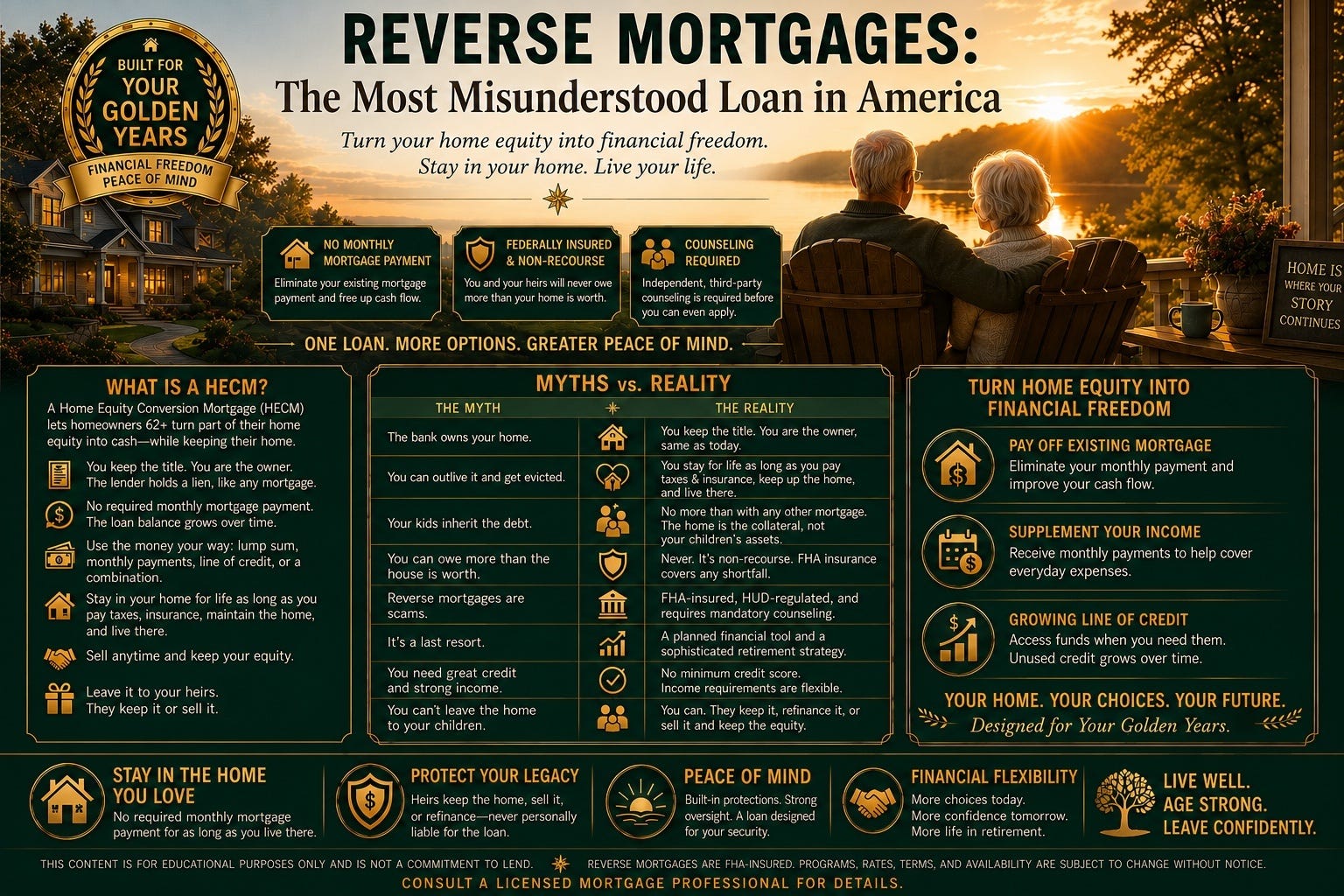
A reverse mortgage (specifically the FHA-insured Home Equity Conversion Mortgage, or HECM) lets a homeowner age 62 or older turn part of their home equity into cash with no required monthly mortgage payment, while keeping their name on the title. It is federally insured, it is non-recourse, and it is one of the only consumer loans in America that requires independent, third-party counseling before you can even apply. It is also the most misunderstood. Many of the things the average person believes about it are outdated, half-true, or flatly wrong.
I want to fix that, because the gap between what this loan actually is and what people think it is has real consequences. It is the difference between a 75-year-old widow choosing between her property taxes and her prescriptions, and that same widow living comfortably in the home she raised her family in.
Picture her. Southern New Hampshire, age 75, widowed two years ago. Her house is worth about $420,000 and she still owes $90,000 on a forward mortgage with a principal-and-interest payment near $1,400 a month (she pays her property taxes and insurance on top of that, as she will continue to do either way). Her Social Security check is roughly $2,150. After the mortgage, she has about $750 a month to cover everything else: food, fuel, insurance, the dentist, the car that needs tires. She is, in the language of retirement planning, house-rich and cash-poor. And she has been told her whole life that a reverse mortgage is a scam that will steal her home.
She did nothing wrong. She planned for the retirement she expected, and then the cost of everything moved out from under her. The inflation data released this June put the annual rate at 4.2 percent, the highest since 2023, and it has now accelerated three months in a row (per the Bureau of Labor Statistics). Groceries are up around 3 percent over the year, gasoline has jumped more than 40 percent on the back of an energy shock, and shelter, the largest line in most household budgets, is up 3.4 percent. Her Social Security cost-of-living adjustment, locked in last fall, never saw this coming. Seniors on fixed incomes absorb rising prices more painfully than almost anyone, because so much of their budget sits in the exact categories rising fastest: food, fuel, utilities, and healthcare. The pinch that was merely uncomfortable two years ago is genuinely painful now, and “wait it out” is not a plan when you are 75.
For her, a reverse mortgage may be the most rational financial move available. Let me walk through why, and dismantle the myths in the order people believe them.
How a reverse mortgage (HECM) actually works
A HECM is a loan, not a sale. You are not selling your house to the bank. You are not selling a slice of it to an investor. You keep the title, exactly as you do now. The Federal Housing Administration insures the loan, which is what makes the consumer protections so strong.
The mechanics are the mirror image of a regular mortgage. On a normal “forward” mortgage, you make a payment every month and the balance shrinks. On a reverse mortgage, you make no required monthly payment and the balance grows, because the interest and insurance get added to it instead of being paid out of pocket. The loan comes due when the last borrower sells, moves out permanently, or passes away.
How much you can access depends on three things: the age of the youngest borrower, current interest rates, and your home’s value (capped at the 2026 FHA limit of $1,249,125, per HUD). Older borrowers and lower rates produce more available funds. You will never get the full value of the home. At today’s rates, a borrower in their early 60s might access roughly 30 percent of the value, and someone in their 80s closer to 45 percent. When rates were lower, those figures were meaningfully higher, which is a big reason the old rules of thumb about reverse mortgages no longer hold.
Most people are asking, “Should I give up my home to get money?” That is the wrong question, and it is built on a false premise. The right question is, “What is the equity in my home actually for, and what is it protecting me from?” Equity that you cannot eat, cannot spend, and cannot access without selling the roof over your head is not doing much for you. A HECM is a tool for putting that frozen equity to work without leaving.
Common reverse mortgage myths (and the truth)
The two myths that do the most damage are the ones about heirs and about losing the home, so let me take them head-on.
What happens to a reverse mortgage when you die
When the last borrower passes, the loan becomes due. The estate or the heirs then choose from a short menu, and the menu is generous.
If the home is worth more than the loan balance (often the case, since home values have historically tended to rise over time, though never guaranteed), the heirs sell it, pay off the loan, and keep every dollar of the difference. The lender does not get the excess equity. Your family does.
If the heirs want to keep the home, they pay off the balance, or refinance it into their own name. They typically get six months to do it, with extensions available while they arrange financing or a sale.
Now the protection almost nobody knows about. If the loan balance has grown larger than the home’s value, the heirs are not stuck. Under HUD’s non-recourse rule, they can settle the loan and keep the property by paying just 95 percent of the home’s current appraised value, no matter how high the balance climbed. The FHA insurance you paid for covers the rest. And if they would rather not keep it at all, they hand the keys to the lender and walk away owing nothing. No deficiency. No collection. No hit to their own finances.
This is the heart of the non-recourse promise: neither you nor your heirs will ever repay more than the home is worth once it sells. You paid for that protection through the mortgage insurance premium, and it is real.
Do you still own your home with a reverse mortgage?
Strip away the fear and look at the day-to-day reality. With a reverse mortgage you still own the house. You still hold title. You still pay your property taxes, your homeowners insurance, and your upkeep, the same obligations you have right now. You can still sell whenever you want and keep your equity. You can still leave it to your children. You can still paint the kitchen, plant the garden, refinance later, or move.
The market still works the same way too. If values rise, your equity rises. If values fall far enough that the balance ends up higher than the home is worth, the non-recourse feature means neither you nor your heirs ever have to cover the shortfall.
Functionally, only two things change. You stop making a required monthly mortgage payment, and the loan balance grows over time instead of shrinking. That is the entire practical difference. Everything else about being a homeowner stays exactly as it was.
And here is a piece almost nobody realizes: you can make payments anytime you want. The monthly payment is not required, but it is never forbidden, and there is no prepayment penalty. If you want to pay the interest each month to keep the balance flat, you can. If you want to throw extra at it in a good year to protect your equity and your children’s inheritance, you can. On a line of credit, voluntary payments do something even better: paying money back restores your available credit, so the dollars you repay become dollars you can draw again later. You decide how fast the balance grows, or whether it grows at all. The loan flexes to your behavior. You are not locked into watching it climb.
Back to the widow: the example that matters most
This is where the loan earns its keep. Watch what happens to her monthly life.
She uses the loan to pay off her $90,000 forward mortgage, which is the one mandatory use of the funds. That single move erases the $1,400 payment that was crushing her and nearly triples the cash she has left at the end of each month. The remaining proceeds, roughly $57,500 at today’s rates, go into a line of credit that quietly grows over time, a cushion waiting for the next surprise bill. She keeps paying her property taxes and insurance, exactly as she did before.
Her usable monthly cash flow goes from about $750 to about $2,150, nearly triple what she had, just by removing one payment. Nothing about her life got smaller. She did not move. She did not sell. She did not borrow from her kids. She turned dead equity into a livable retirement, in the house she wants to be in. This is, in my view, one of the best applications of a reverse mortgage: a struggling senior who is asset-rich and income-poor, staying put and living better.
Use of funds: you choose the shape of the money
A HECM is not one-size-fits-all. Outside of paying off any existing mortgage (required), you decide how the money comes to you, and you can mix the options:
A lump sum at closing for a specific need, like a roof, a medical bill, or eliminating other debt. A monthly payment (called tenure for life, or term for a set number of years) that supplements income, as the widow did. A line of credit you draw on only when you want, and here is the part professionals love: the unused portion of a HECM line of credit grows every year, independent of what the home does. A line opened at 70 and left mostly untouched can be dramatically larger at 85. Retirement researchers treat this “standby” line as a buffer asset, money to draw from in a down market so you are not forced to sell investments at a loss. Most people use a blend: pay off the old mortgage, take a little monthly, and keep a growing line for the unknown.
One spouse needs to be 62, not both
If you are married (and not separated), only one of you needs to be 62 to qualify. The younger spouse must be listed as an “eligible non-borrowing spouse,” and under HUD rules adopted after a 2013 federal court ruling, that spouse is protected. If the borrowing spouse passes first, the non-borrowing spouse can remain in the home for life without the loan being called due.
Be straight with yourself about the tradeoff, though, because this is where a lot of marketing goes quiet. HUD bases the loan amount on the age of the youngest person, borrower or non-borrowing spouse. So a 70-year-old with a 60-year-old spouse will qualify for less than a 70-year-old with no younger spouse on the picture. The protection is excellent. It is not free. Run both numbers before you decide.
Reverse mortgage requirements: credit, income, and counseling
This is not a forward mortgage, and it does not screen you like one.
Credit is flexible. HUD sets no minimum credit score. Lenders look at whether you have paid your property taxes, insurance, and obligations responsibly, not at a FICO cutoff. A rough patch in your past does not automatically disqualify you.
Income requirements are modest. There is no debt-to-income hurdle like a normal loan, because there is no monthly mortgage payment to qualify against. HUD runs a “financial assessment,” which is really a check that you can keep paying your taxes, insurance, and basic obligations. If your history or income is thin, the fix is usually a Life Expectancy Set-Aside, where a portion of the proceeds is reserved to pay your taxes and insurance automatically. That can turn a “no” into a “yes,” not the other way around.
Counseling is mandatory. Before you can move forward, you must complete a session with an independent, HUD-approved HECM counselor who does not work for the lender and does not get paid based on whether you take the loan. They walk you through the costs, the alternatives, and the obligations. The certificate is required before the appraisal can even be ordered. I consider this one of the best features of the program, not a hurdle. No one is getting talked into this loan in a parking lot.
Reverse mortgage costs: what's high, and what it's worth
I am not going to soft-pedal this. HECM closing costs are higher than a normal mortgage. You pay an upfront FHA mortgage insurance premium of 2 percent of the home’s value (up to the lending limit), plus a lender origination fee that is capped by law (2 percent of the first $200,000 and 1 percent above that, never more than $6,000), plus the usual third-party costs for appraisal, title, and recording. There is also an ongoing annual insurance premium of 0.5 percent on the balance.
Two things make this manageable. First, nearly all of it can be financed into the loan, so it comes out of your proceeds rather than your checkbook. You are generally not writing a large check at closing. Second, that insurance premium is exactly what buys you the non-recourse protection, the guarantee that you and your heirs will never owe more than the house is worth, and the assurance that your payments keep coming even if the lender fails.
Are the costs “worth it”? Honestly, it depends on the use. For someone planning to move in two years, probably not. For the widow above, or a couple using a growing line of credit to protect a 25-year retirement, the cost is small against what it buys. I would rather tell you that plainly than pretend the fees do not exist.
Buying a home with a reverse mortgage (HECM for Purchase)
This is the feature that surprises even real estate agents. The HECM for Purchase (H4P) lets you buy a home using a reverse mortgage, in a single transaction, with no monthly mortgage payment for as long as you live there.
Here is the scenario I see often. A couple sells their longtime home for $450,000 in cash and wants to move closer to their adult children. The instinct is to pay all cash for the new place and be “debt-free.” Watch what that actually costs them in flexibility.
Run the actual numbers for a buyer age 73 at today’s pricing (a 6.75 percent expected rate with a 2.25 percent margin, the figures that size the loan), and here is how the two paths compare:
Here is the part most articles will never tell you, and the part that makes this loan so easy to get wrong. How much you can borrow is not set by your note rate. It is set by the “expected rate,” a long-term index plus the lender’s margin, and the available funds shift as that rate and the buyer’s age change. That is why the lazy “you only put down about half” rule of thumb you will find all over the internet is unreliable. At this buyer’s age and today’s pricing, the down payment runs closer to 65 percent. The figure is whatever it is on the day you lock, which is exactly why you run it rather than trust a number in an article.
Now look at what that buyer actually walked away with, because this is the part that should stop you. A 73-year-old moved into the home they wanted, close to their kids, owes nothing on it every month for the rest of their life, and still has nearly $159,000 sitting in the bank. For a senior, that is not a consolation prize. That is the entire picture of their retirement, changed.
Think about what $159,000 does at that age. It is years of property taxes and homeowners insurance covered without touching a dollar of income. It is a healthcare and long-term-care cushion that lets you sleep at night. It is the money that fills the gap Social Security never quite covers, the difference between rationing and simply living. The all-cash buyer has a paid-off house and an empty account, and the next surprise bill, a roof, a hospital stay, a bad year, hits them with nothing in reserve. This buyer has the same house, the same no-payment lifestyle, and a six-figure safety net underneath it. Ask any retiree who has been blindsided by a five-figure bill which they would rather have at 73. Most will not hesitate.
“Debt-free” feels virtuous, and the instinct to pay cash runs deep. But for a retiree, liquidity is usually worth far more than a fully paid-off house, because you cannot eat your equity and a paid-off home will not cover the surgery. This couple got both the house and the cash. That is the case for HECM for Purchase, and it gets stronger, not weaker, the more honestly you run the numbers.
The behavioral piece, because it is the whole ballgame
I write constantly that behavior beats math in real-world finance, and nowhere is that truer than here. The resistance to reverse mortgages is almost never about the numbers. It is psychological.
Three patterns do the damage:
Mental accounting. People treat a paid-off home as sacred and untouchable, a category of money that is not allowed to be spent, even while they ration their own medication.
The moralizing of debt. The inherited belief that any loan is a personal failure, which turns a rational tool into a source of shame.
Loss aversion around the inheritance. Families reject a loan to “protect the kids’ inheritance,” not realizing that the non-recourse structure and the 95 percent rule shield the heirs from any debt or shortfall, while the loan often makes the parent’s final years dramatically better. The inheritance may end up smaller, but it is never negative, and the tradeoff is a parent who lived well.
That last one deserves a hard look. Which is the better legacy: a parent who suffered quietly to preserve a house, or a parent who lived their last decade with dignity and breathing room? The math on a reverse mortgage is straightforward, the same way the math on a refinance is straightforward but routinely misread, which I broke down in The Amortization Trap. The hard part, as always, is what we let ourselves believe about money. If that tension resonates, the reading list at the end of my Behavior Beats Math post goes deeper than I can here.
Before the loan, have the family conversation
There is one step worth taking before any reverse mortgage application, and it costs nothing: an honest conversation with your adult children.
If money is tight, it is fair to ask whether the family is in a position to help. Some children can comfortably step in, and many would genuinely want to know a parent is struggling rather than find out years later. For some families, that turns out to be the better answer and the reverse mortgage stays on the shelf. There is no shame in a parent asking, and no shame in a child saying they simply are not able to. Life is expensive for the younger generation too, and being unable to help is not a failing.
But here is the gentle truth that needs saying out loud. If the children are not in a position to help support their parents, they have also set down any standing to object to how the parents take care of themselves. It is not fair to decline to help and then push back on a parent using their own home equity to live well. That equity belongs to the parents. It was never the children’s money, and an expected inheritance is a hope, not a debt the parents owe anyone. A parent’s comfort, dignity, and peace of mind in their final decades come first.
The healthiest version of this conversation is the one where everyone is honest and no one is made to feel guilty. Sometimes the kids step in and the loan proves unnecessary. Sometimes the kids cannot, they say so kindly, and they support their parents’ decision to use the tool that lets them live well. Both of those are good outcomes. The only bad outcome is a parent quietly going without, to protect an inheritance nobody ever asked them to preserve.
For the Realtors and financial advisors reading this
You have clients this fits, and you are probably writing some of them off. Here are the three you are most likely sitting across from:
The asset-rich, income-light retiree. Strong savings or a healthy portfolio, but the modest documented income that makes a conventional approval hard. This is the same borrower I described in my piece on DSCR and asset depletion loans: a perfectly good client the agency box refuses to see.
The downsizing buyer who wants to keep their cash. They are about to pay all cash for the next home. A HECM for Purchase lets them buy the same house, carry no monthly mortgage payment, and keep six figures in the bank instead. Happier client, cleaner file.
The house-rich, cash-poor senior. A longtime owner stretched thin on a fixed income who assumes the only option is to sell. Paying off the existing mortgage, or adding a growing line of credit, can let them stay put and live better.
Knowing this product exists is the edge. The worst outcome for your client is not that a reverse mortgage turned out to be wrong for them. It is that no one at the table ever told them it was an option.
What to do this week
If you are 62 or older, or you are an adult child watching a parent stretch a fixed income too thin, here are the concrete next steps. Pull a rough number on the home’s value and any remaining mortgage balance. Write down the real monthly problem you are trying to solve, whether that is an existing payment, thin cash flow, a looming repair, or a move. Schedule the free HUD counseling session early, since it is required and it costs you nothing to learn. And model the actual figures for your specific age, home value, and goal before you form an opinion, because the generic numbers in any article (including this one) are not your numbers.
Let me run your numbers, honestly
If any of this fits your situation, a struggling parent who wants to stay home, a downsizing move where you would rather keep your cash, or a line of credit you want to set up while rates and limits are favorable, reach out. I will model it straight: what you would actually receive, what it would cost, what it would do to your monthly life, and just as important, when a reverse mortgage is the wrong tool and you should not do it. It takes about fifteen minutes. The decision shapes the rest of your retirement. I am a mortgage originator licensed in New Hampshire, Massachusetts, and Maine, and this is the analysis I would want if I were sitting on your side of the table.
Reverse mortgage FAQ
What is a reverse mortgage?
A reverse mortgage is a loan for homeowners age 62 or older that converts part of their home equity into cash with no required monthly mortgage payment. The most common type is the FHA-insured Home Equity Conversion Mortgage (HECM). You keep the title to your home, and the loan is repaid when the last borrower sells, moves out permanently, or passes away.
Do you still own your home with a reverse mortgage?
Yes. You keep the title and remain the owner, exactly as before. The lender holds a lien, like any mortgage. You continue to pay property taxes, homeowners insurance, and upkeep, and you can sell or leave the home to your heirs at any time.
What happens to a reverse mortgage when you die?
The loan becomes due. Your heirs can sell the home, pay off the balance, and keep any remaining equity; keep the home by paying off the balance, or 95 percent of its appraised value if the balance is higher; or hand the home to the lender and owe nothing. Because a HECM is non-recourse, neither you nor your heirs ever repay more than the home is worth once it sells.
Can you buy a home with a reverse mortgage?
Yes, through a HECM for Purchase. You make a one-time down payment, often around half the price depending on your age and rates, and the reverse mortgage covers the rest, with no monthly mortgage payment. It lets downsizing buyers keep a large share of their cash instead of paying all cash.
What credit score do you need for a reverse mortgage?
HUD sets no minimum credit score. Lenders run a financial assessment to confirm you can keep paying your taxes and insurance. If your history or income is thin, a Life Expectancy Set-Aside can reserve funds for those bills and still get you approved.
Is a reverse mortgage a good idea?
It depends on your situation. It can be an excellent tool for a house-rich, cash-poor retiree who wants to stay home, or for a downsizing buyer who wants to preserve liquidity. It is usually a poor fit if you plan to move within a few years, because the upfront costs are high. Independent HUD counseling is required before you apply.
About the author
Gary Field is a Senior Loan Officer at NewFed Mortgage Corp, focused on mortgage lending, behavioral finance, and the hidden math behind housing. His work spans the full range of home financing, including conventional (Fannie Mae and Freddie Mac), FHA, VA, reverse mortgages (HECM), and non-QM programs such as DSCR and asset depletion loans.
He serves buyers and homeowners across New Hampshire, Massachusetts, and Maine, with a particular focus on Southern New Hampshire.
Gary is the founder of Truth in Refi, a publication exploring mortgage psychology, housing market structure, affordability, refinancing, and financial decision-making.
truthinrefi.com gary@truthinrefi.com 603-566-9346
NMLS #2738702 (Gary Field) NMLS #1881 (NewFed Mortgage Corp) NewFed Mortgage Corp is an Equal Housing Lender.
Very good article. Thank you.
Great article. I learned a lot!